Mileage Reimbursement Rates 2026: Complete Guide to IRS and ACI Rates

Mileage reimbursement represents one of the most important tax deductions for self-employed professionals, employees, and entrepreneurs in the United States. Whether you’re a real estate agent traveling thousands of miles every year, a consultant who frequently moves between clients, or simply an employee who uses your personal vehicle for work, understanding the IRS 2026 mileage reimbursement rates can save you thousands of dollars in taxes. Every year the Internal Revenue Service (IRS) updates these rates based on inflation and vehicle operating costs, and 2026 is no exception with significant changes from the previous year.
In this comprehensive guide, we will explore the 2026 IRS rates for various usage categories, how deductibility varies based on work context, how to correctly calculate your deductions, and what documents the IRS requires to support your claims. Additionally, you’ll discover how modern technology like the Magica Mileage Tracker app can significantly simplify the tracking and documentation process, ensuring tax compliance with maximum privacy and ease of use.
The IRS 2026 Mileage Reimbursement Rates: Detailed Analysis
The IRS has officially announced the mileage reimbursement rates for 2026, and as each year, these reflect the average costs of operating a vehicle in the United States. Understanding these rates is essential for maximizing your legitimate tax deductions.
Specific Rate by Usage Category 2026
IRS rates vary significantly based on the type of vehicle use. Here is the complete breakdown:
| Usage Category | 2026 Rate | Change from 2025 |
|---|---|---|
| Business/Work | $0.67 per mile | +$0.02 |
| Medical/Dental | $0.23 per mile | Unchanged |
| Charity | $0.14 per mile | Unchanged |
| Relocation (Qualified Military) | $0.23 per mile | Unchanged |
The most significant increase concerns the business rate, which has risen from $0.65 to $0.67 per mile. This 3% increase reflects rising costs of maintenance, gasoline, and vehicle wear and tear. For a real estate agent who drives 20,000 miles annually for work, this difference translates to an additional $400 in deductions ($0.02 × 20,000 miles).
How Mileage Reimbursement Works: Who Can Benefit
Not everyone can benefit from mileage reimbursement in the same way. Your ability to deduct mileage expenses depends on several factors, including your employment status and the reason for travel.
Who Can Claim the Mileage Deduction
- Employees: If your employer does not fully reimburse you for business travel expenses, you can deduct unreimbursed miles as miscellaneous itemized deductions (only if you exceed 2% of adjusted gross income threshold)
- Self-Employed and Business Owners: You can deduct all business miles directly from your tax return Schedule C
- Independent Contractors: Similar to self-employed individuals, you can deduct project-related travel costs
- Sales Representatives/Real Estate Agents: If your income is commission-based, you are entitled to the full deduction
- Researchers and Scientists: Specific types of traveling research are deductible
Standard Rate Method vs. Actual Expense Method
The IRS allows you two approaches for calculating mileage deductions:
1. Standard Rate Method (Recommended)
You simply use the IRS rate per mile multiplied by the number of miles driven. This is the simplest method and chosen by over 90% of taxpayers. You don’t need to track actual expenses for fuel, maintenance, or insurance.
2. Actual Expense Method
Track and deduct all actual expenses: gasoline, oil, maintenance, insurance, registration, fuel taxes, parking, tolls, and depreciation. This method is more complex but can be advantageous if your vehicle has particularly high maintenance costs.
Which one to choose? For most professionals, the standard rate method is sufficient and far less labor-intensive. The actual expense method makes sense only if your documented expenses significantly exceed the standardized deduction.
Step-by-Step Calculation of Mileage Deduction: Practical Example
Let’s put what we’ve learned into practice with a concrete example. Suppose you are Maria, a real estate agent in Northern California who drove 20,000 miles for work in 2026.
Step 1: Gather Mileage Data
Maria must document all of her work miles. This is where many professionals fall short or lose money. With an automatic tracking app like Magica Mileage Tracker, this step is practically automatic. The app automatically detects trips and allows you to classify them as work or personal with simple tags.
Step 2: Verify Documentation Compliance
Maria must ensure her documentation is complete. The IRS requires:
- Date of travel
- Destination (city or starting and ending point)
- Purpose of travel (client meeting, property showing, etc.)
- Number of miles
Step 3: Multiply by the IRS Rate
Calculation = 20,000 miles × $0.67 per mile = $13,400 tax deduction
If Maria is in the 24% tax bracket, this translates to approximately $3,216 reduction in income tax. This is real money that Maria can keep in her bank account.
Step 4: Document and File
Keep detailed records for at least 3-6 years in case of an audit. Magica simplifies this step by giving you the ability to export all your trip data in PDF or CSV formats ready for the IRS, with all required data fields already filled in.
Documentation Requirements: What the IRS Requires
Documentation is the foundation of legitimate mileage reimbursement. Without a clear and contemporaneous record of your trips, you risk having your entire deduction disallowed in case of an audit.
The IRS-Compliant Mileage Log
The IRS requires a “contemporaneous mileage log,” which means your record must be created at the time of travel or shortly after, not months later when filing taxes. Each entry must include:
- Date: Day, month, year of travel
- Starting and ending point: City names or specific addresses
- Business purpose: A brief but specific description (e.g., “Client meeting at 123 Oak Street,” not just “Business meeting”)
- Miles driven: The starting and ending odometer reading, or total distance
Common Audit Triggers for Mileage Deductions
Certain patterns increase the risk of IRS audit. Here’s what to avoid:
- Round numbers: Claiming exactly 15,000 or 20,000 miles per year looks suspicious
- Year-to-year inconsistency: Jumping from 5,000 miles to 35,000 miles without a consistent business reason
- Lack of contemporaneous documentation: Handwritten records created months after the fact
- Lack of specific details: Vague purposes like “miscellaneous business” instead of identifying specific clients or meetings
- Excessive mileage proportion: If your work mileage represents 95%+ of your total miles, the IRS might be skeptical
Using an automated tracking app drastically reduces these risks because it creates an instant chronological record that’s difficult to contest.
Automate Compliant Tracking: Magica Mileage Tracker
Given the importance of compliant documentation, the technology you use to track your miles is crucial. Magica Mileage Tracker was specifically designed to automate the difficult process of tracking mileage expenses while maintaining maximum privacy and compliance.
Automatic Trip Detection
Magica uses your iPhone’s GPS to automatically detect when you start and finish a trip. You don’t need to remember to start a timer or manually enter travel information. The app instantly creates a contemporaneous record of every movement, exactly as the IRS requires.
Intelligent Classification with Business Tags
Once the app has detected a trip, you can instantly assign it a tag to classify it as “Work,” “Personal,” “Medical,” or “Charity.” Magica remembers your patterns and can automatically suggest the correct classification for future trips to the same destinations.
Compliant Export for Tax Filing
When it’s time to file taxes, Magica generates detailed PDF or CSV reports containing all the data required by the IRS: date, destination, purpose, and miles driven. No more searching through poorly organized spreadsheets or trying to reconstruct records from messy documents.
Maximum Privacy – No Cloud Storage
A distinctive feature of Magica is its commitment to total privacy. Unlike many tracking apps, Magica keeps all your data locally on your device. It does not sync with cloud servers, does not sell your data, and does not track your movements beyond what you knowingly control. If privacy is a priority for you (and it should be), Magica is the right choice.
Support for Electric Vehicles and CarPlay Ultra
Magica is not limited to traditional gas-powered vehicles. If you own an electric car, Magica also tracks your charging stops and integrates an interactive map of charging stations. Additionally, the app is fully optimized for CarPlay and CarPlay Ultra, allowing you to classify your trips right from your car’s dashboard without distraction.
With Magica, tax compliance is no longer a tedious task—it’s an automated process that happens while you drive.
2025 vs 2026 Comparison: How to Plan
The variation of reimbursement rates from year to year has implications for tax planning. The increase in the business rate from $0.65 to $0.67 (a 3% increase) is significant, especially for those who drive many miles.
If you are self-employed with predictable income cycles, consider how these rate changes could affect your total tax liability. While you cannot control IRS rates, you can better plan your expenses and reimbursements by knowing in advance what the tax benefits will be.
Conclusion: Maximizing Your Mileage Reimbursement in 2026
Mileage reimbursement is one of the most straightforward and legitimate tax deductions available to professionals, self-employed individuals, and entrepreneurs. With the 2026 IRS business rate set at $0.67 per mile, even a small increase in documented mileage translates to hundreds of dollars in tax savings.
The key to success is meticulous and contemporaneous documentation. A disorganized or incomplete record is worthless, regardless of how many miles you actually drove. This is why investing in an automated tracking solution like Magica Mileage Tracker is a smart decision: it eliminates manual administrative burden, creates IRS-compliant records at the time of travel, and protects your privacy by keeping all data locally on your device.

Try Magica for Free
Download the app and start automatically tracking your business trips. No credit card required.
Download Now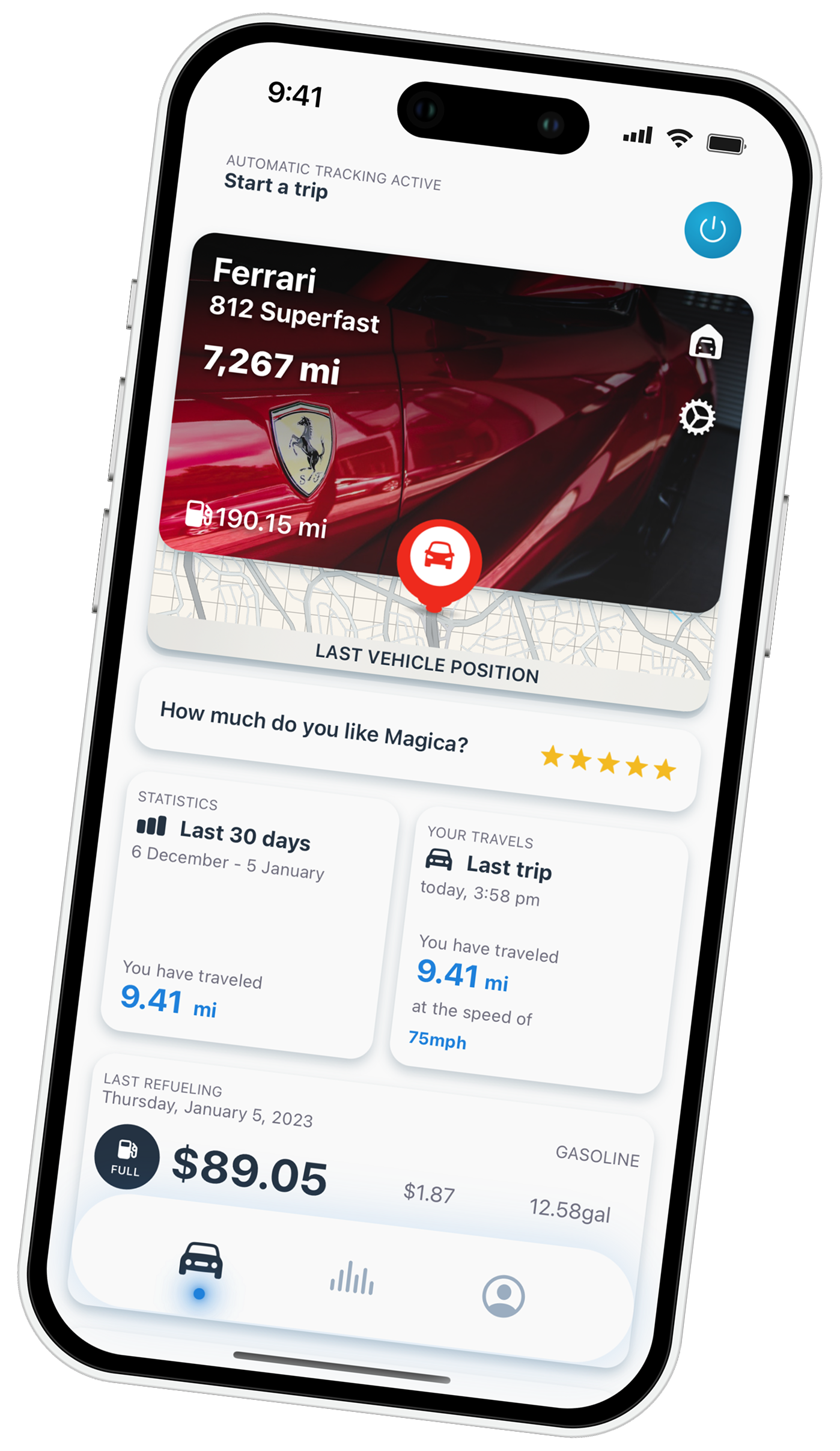
Don’t leave money on the table. Start tracking your work trips today with maximum accuracy and compliance. Download Magica Mileage Tracker for free and discover how thousands of professionals have simplified managing their mileage deductions while maintaining maximum privacy and tax peace of mind.