ATO Logbook App in 2026–27: the Rate Lasts a Year, the Logbook Lasts Five, and the Free One Lives on a Single Phone

On 25 August 2026 I pulled the Australian results for logbook app and for ato logbook app and read what came back. The two searches are one word apart, both carry an AI Overview, and they return almost opposite pages.
logbook app returned 19 organic results. Eight of them are learner-driver logbooks — the NSW app, the Queensland one, Plates Plus in Tasmania, Roundtrip, LogMyDrive. Not one result came from the ATO. ato logbook app returned 18 organic results and six of them are published by the ATO itself, starting at position one with myDeductions. Not one learner-driver app appeared.
So the first useful thing to know is that in Australia the biggest single group of results for “logbook app” is the one you fill in before you get your Ps, and the tax one only surfaces if you say ATO out loud. The second useful thing is what none of the comparison pages ranking for either search mention: the ATO publishes three restrictions on its own free app, the rate changed on 1 July, and a logbook has to survive far longer than the year you write it in.
I build Magica, a logbook and mileage tracker that keeps everything on your phone, so I have a side here. What follows is what the ATO actually requires, what the two best-known options cost and keep, and where mine is different — with the primary sources so you can check every number yourself.
The two methods, and what each one wants from you
The ATO gives you two ways to claim a car you own or lease, and they ask for completely different records.
Both of them, though, only start once the trip itself qualifies — and the trip rules are older and stricter than the methods. Which trips you can claim, and which costs are not car expenses at all, is the part that decides the size of the number before either method touches it.
Cents per kilometre: one number, a hard ceiling
For the income year that started on 1 July 2026, the rate is 91 cents per kilometre. That is not a guideline — it is set by legislative instrument. The Income Tax Assessment (Cents per Kilometre Deduction Rate for Car Expenses) Determination 2026, registered on 23 June 2026, says at section 6 that “the rate of cents per kilometre for cars for the income year commencing on 1 July 2026 is 91 cents per kilometre.” The ATO’s cents per kilometre page lists the same figure alongside the previous years: 88 cents for 2024–25 and 2025–26, 85 cents for 2023–24, 78 cents for 2022–23, 72 cents for 2020–21 and 2021–22. Whether that ceiling beats a logbook depends on what your car costs to run, and the arithmetic is in logbook method vs cents per km.
The 91 cents is the deduction rate, not what an employer has to pay: the Clerks Award pays $1.00 a kilometre from 1 July 2026, and the difference is taxed as wages. What a car allowance actually is, and what it does to your tax, super and the new $1,000 standard deduction, is in car allowance in Australia.
And 91 is not one number: the explanatory statement calls it an 89-cent base plus a temporary 2-cent uplift, with next year’s indexation applied to the 89. Why the ATO km rate is 91 cents, and what it does next July reads the instrument line by line.
The method caps you at 5,000 work-related kilometres per car per year, so the most it can ever be worth is 5,000 × $0.91 = $4,550. The rate, in the ATO’s words, “covers all of your car expenses including decline in value, registration and insurance, maintenance, repairs and fuel costs” — you cannot add anything on top. And you cannot claim decline in value at all if you use it.
The trap is the word “free”. You do not need receipts, but you do need “a record to show how you calculate your work-related kilometres”. A number you invent in June is not a record.
Logbook method: twelve weeks that pay for five years
The logbook method claims the work-related portion of your actual costs — fuel, electricity, servicing, rego, insurance, decline in value. There is no 5,000 km ceiling, which is why it is worth more for anyone who really drives for work.
The price is the record. The ATO’s logbook method page says your logbook must:
- “cover at least 12 continuous weeks and be broadly representative of your travel”
- “include the reason and purpose, as well as the destination of every work-related journey, the odometer reading at the start and end of each journey, and the total kilometres travelled on the journey”
- “include odometer readings for the start and end of the logbook period and the total kilometres travelled during that period”
Two more rules decide which app can actually do this job. Every entry “must be made at the end of the journey or as soon as possible afterwards” — so a logbook cannot be reconstructed at tax time, by you or by any software. And if you run two vehicles: “If you are using the logbook method for 2 or more cars, keep a logbook for each car and make sure they cover the same period.” Two cars means two logbooks running side by side, not one merged list.
Twelve continuous weeks is 84 days. That is the whole cost of the method, and it buys a percentage.
The requirements behind that summary are shorter and stranger than the summary, and they are worth reading once: I have gone through what Division 28 actually asks a logbook to contain — including the rule that lets a run of same-day jobs be a single entry, and the two things that force a new logbook before the five years are up.
The five-year problem nobody prices in
Here is the part that decides which app you should pick, and it has nothing to do with features.
“Your logbook is valid for 5 years,” the ATO says. In each of the four years after the first, you keep only the odometer readings and apply the percentage you already worked out. Then: “You must retain your logbook and odometer records for 5 years after the end of the latest income year that you rely on them to support your claim.”
Put those two sentences together with a calendar. A logbook you start this September is valid through the 2030–31 income year. If you lean on it in that fifth year, you have to keep it for five more — and section 28-150 of the Income Tax Assessment Act 1997 starts that clock on the due day for lodging the return for that year, not on 30 June. Lodging your own return, that is 31 October 2031, so the records have to survive to 31 October 2036. Twelve weeks of typing in 2026 has to still be readable in 2036. The full set of ATO logbook requirements is where that arithmetic comes from.
Now look at the rate again over the same kind of span: 72, 78, 85, 88, 91 cents. Five different figures across seven income years. The number the internet argues about changes almost every year; the percentage your logbook produces does not. Which is the real argument for the logbook method — and the real argument for caring where that record physically lives.
An app that holds a decade of evidence is not a subscription. It is storage.
myDeductions: free, from the ATO, and limited in three ways it tells you about
myDeductions is the record-keeping tool inside the ATO app, and it ranks first for ato logbook app for good reason: it is free, it is official, and the logbook method page names it directly — “You can keep an electronic logbook using the myDeductions tool in the ATO app, or keep a paper logbook.”
What the comparison pages tend to skip is the fine print the ATO publishes on its own myDeductions page:
- Records live on the handset. “Records you add are stored locally on your device.”
- Backup is manual. “You should back up your data to a separate location regularly using the Back up feature in myDeductions in case your device is broken, lost or stolen as this isn’t an automatic process.”
- One device, one upload. “Only record your information on a single device throughout the year, because you can’t consolidate sets of records and you can only upload once per financial year.” And: “Multiple people can’t use one device.”
None of that makes myDeductions a bad tool. It makes it a specific one: it fits a person with one phone, one financial year in view, and the discipline to hit Back up. Read it against the five-year rule above and the mismatch is obvious — the ATO asks you to hold a record for up to a decade in a tool that, by its own documentation, does not back itself up and cannot merge two sets of records if you change phones mid-year.
If you use it, put a recurring reminder in your calendar for the backup. That single habit is the difference between a valid claim and a lost one.
Driversnote in Australia: what it costs
Driversnote is the best-known paid option here and the one most people compare against. It is a capable app — automatic detection that combines GPS with the vehicle’s accelerometer, clean exports, and genuinely good back-office tools for anyone collecting logs from a crew. Its Australian pricing page, read on 25 August 2026, sets out four tiers, with prices excluding GST:
- Free — $0. “Easy reporting of up to 15 trips” a month.
- Pro — $17 per month. Unlimited trips, edit log, public API.
- Teams — $17 per licence per month, for 2–10 users, adding admin web tools for collecting and validating reports.
- Teams+ — custom, for 11 or more users, adding single sign-on and a dedicated customer success manager.
Two numbers matter. Pro at $17 a month is $204 a year excluding GST, about $224 including it — reasonable for the category, and per driver rather than per vehicle, so it stays flat if you are one person and multiplies the moment a crew is involved. And the iBeacon, the small Bluetooth device that makes automatic tracking reliable, is listed at $60 and comes free with a yearly subscription. Driversnote is straight about why it exists: motion tracking “will activate whenever you’re moving fast”, including carpooling and public transport, while a beacon that stays in the vehicle only sees trips in that vehicle.
The free tier is where the logbook method breaks. Fifteen reportable trips a month, across a 12-week logbook period, is roughly 41 trips in total. A sparky or a plumber hitting four job sites a day gets there in ten working days and still has ten weeks of the period to run. The free plan is a trial of the app, not a way to complete a logbook.
Where Magica is different
I built Magica around the part of this that is storage rather than software.
Your logbook stays on your phone, and it still gets backed up. There is no Magica account and no server of mine holding your trips — everything is on-device and encrypted. On iPhone, backups go to your own iCloud, automatically — which is exactly the step myDeductions asks you to remember to do by hand. That combination is the whole point: local like the ATO’s tool, backed up like a cloud one, without a company in the middle.
It is not tied to one handset. Magica syncs between iOS and Android in real time, so replacing a phone mid-year does not orphan a logbook period — and there is nothing to consolidate later, because it was never split.
Two cars, two logbooks, same period. The garage is unlimited, and Auto Switch recognises which vehicle you are driving over Bluetooth or audio, so a ute and a family car keep separate logbooks running side by side without you correcting anything. That is the ATO’s two-car rule, handled by the thing that already knows which car you got into.
Both methods, worked out for you. Trips are detected automatically by motion and Bluetooth, classified Work or Personal with a swipe, and your business-use percentage is calculated as you go. Reports export as PDF or CSV for your accountant, ready for either the logbook method or cents per kilometre. Odometer history is kept separately, so the start-and-end readings the ATO wants for the period are not something you have to dig for.
And it covers the rest of the car. Fuel and EV charging with running consumption and cost, a charging-station map, servicing history, and reminders for insurance, rego and roadworthy. Voice logging in plain English — “filled up 45 litres for 78 dollars” — plus native CarPlay, and a local API with MCP support in early access if you want to ask an AI assistant about your own driving data without any of it leaving the phone.

Try Magica for Free
Download the app and start automatically tracking your business trips. No credit card required.
Download Now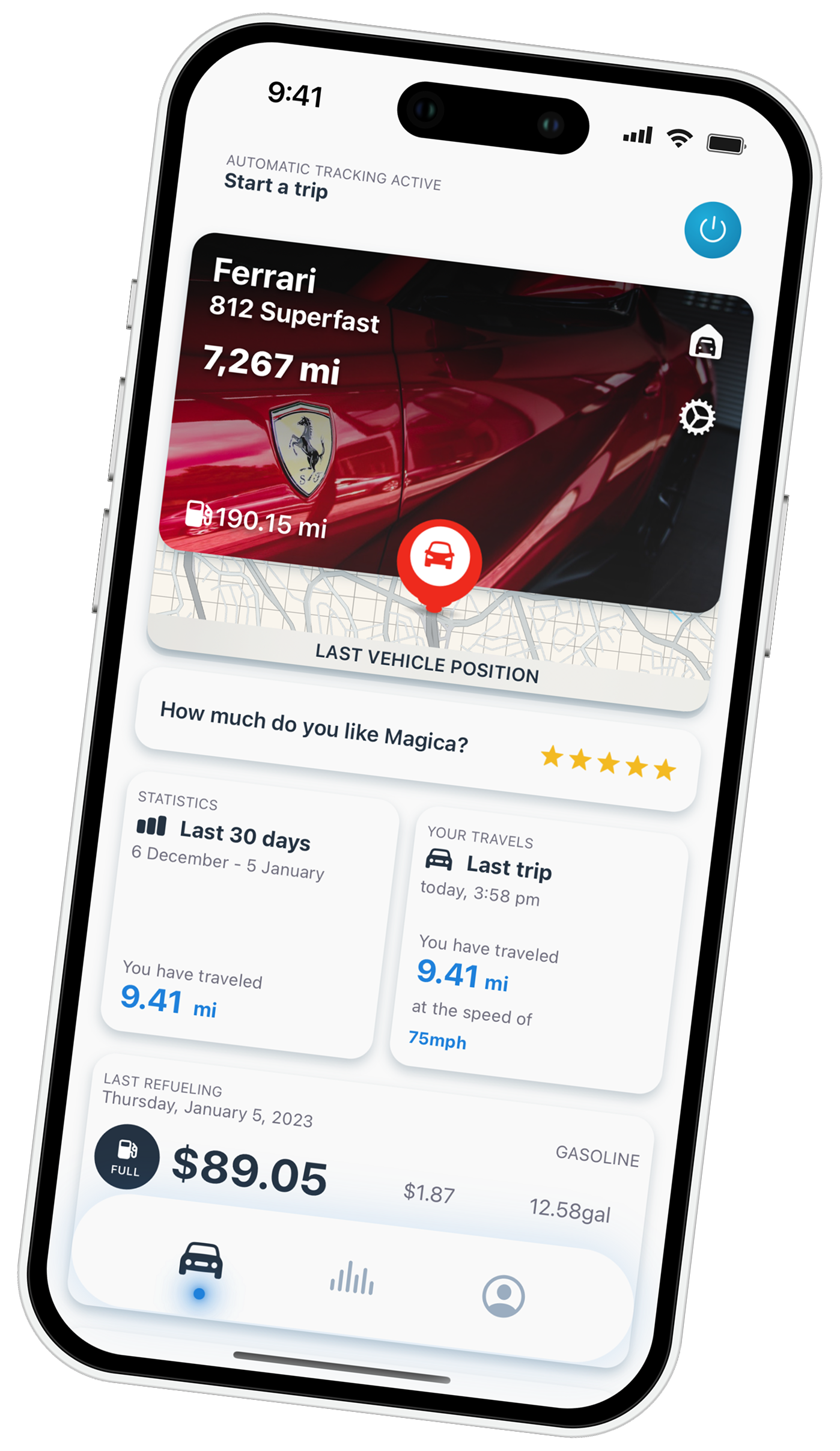
Side by side
| myDeductions | Driversnote | Magica | |
|---|---|---|---|
| Cost | Free | Free tier, Pro $17/mo ex GST | Free to start |
| Trip limit | None stated | 15 reportable trips/month on free | No monthly cap |
| Where records live | On your device | In your Driversnote account, on iOS, Android and web | On your device, encrypted |
| Backup | Manual, “isn’t an automatic process” | Held in the account | Automatic to your own iCloud, on iPhone |
| More than one device | “a single device throughout the year” | Yes, via the account | Yes, iOS and Android sync |
| Multiple vehicles | Not stated | Yes | Unlimited, with automatic switching |
| Hardware for reliable auto-tracking | — | iBeacon, $60, free yearly | None |
| Scope | Records and receipts | Mileage log | Whole vehicle: trips, fuel, servicing, rego |
| Fleet admin tools | — | Yes, Teams and Teams+ | No, single-user by design |
What no app can do for you
Automation stops at distance and route. Three things stay yours whichever app you pick, and they are the three the ATO checks.
Purpose. The logbook must record “the reason and purpose, as well as the destination of every work-related journey”. No tracker knows why you drove somewhere. Adding a note at the end of a job takes five seconds and it is the part an auditor reads.
Timeliness. “Each journey in your logbook must be made at the end of the journey or as soon as possible afterwards.” A month of trips classified in one sitting the night before lodging is not a contemporaneous record, no matter how accurate the GPS was.
The receipts, if you use the logbook method. Fuel and oil, rego, insurance, servicing, tyres, repairs, interest, plus how you worked out decline in value. Cents per kilometre is the method that lets you skip these; the logbook method is not.
And the honest limit on the deduction itself: for decline in value there is a car limit — $69,674 for 2025–26 — and the Commissioner’s effective life for a car is generally eight years, so an expensive vehicle does not depreciate faster just because it cost more.
When Driversnote or myDeductions is the better pick
I am not going to pretend Magica wins for everyone.
Choose Driversnote if you manage a crew. Teams and Teams+ give admins a web console to collect, validate and approve everyone’s reports, plus single sign-on and a dedicated contact. Magica is single-user and on-device by design, so it has no central fleet dashboard. That is a real job it does not do.
Choose Driversnote if you want the beacon. If false trip starts drive you mad and you would rather solve it with hardware in the vehicle than with software on the phone, that is a legitimate preference and the iBeacon is a good implementation of it.
Choose myDeductions if your tax life is simple and free matters most. One phone, one financial year, receipts photographed as you go, records uploaded once at tax time. It is made by the people who assess the claim, which is worth something. Just set the backup reminder.
Choose Magica if the record has to outlive the year. If you would rather your five-year evidence sat on your own device with an automatic backup, if you run more than one vehicle, or if you want the fuel, servicing and rego history in the same place as the kilometres, that is what I built it for.
If you are weighing more than one option, I have written the same breakdowns for TripLog, MileIQ and Everlance, and a longer piece on how to choose a mileage app in the first place.
Frequently asked questions
What is the ATO cents per kilometre rate for 2026–27?
91 cents per kilometre, for the income year that commenced on 1 July 2026. It is set by the Income Tax Assessment (Cents per Kilometre Deduction Rate for Car Expenses) Determination 2026, registered on 23 June 2026, and the ATO lists it alongside 88 cents for 2024–25 and 2025–26, 85 cents for 2023–24 and 78 cents for 2022–23. The method is capped at 5,000 work-related kilometres per car, so the maximum it can produce is $4,550.
How long does an ATO logbook have to run?
At least 12 continuous weeks, and it must be “broadly representative of your travel”. That is 84 days. The logbook is then valid for 5 years, unless your circumstances change enough that it stops representing your work-related use — a new job or a house move are the ATO’s own examples — in which case you start a fresh 12-week period.
Is the ATO’s free myDeductions app enough for a logbook?
It can be. The ATO names it on the logbook method page as an accepted way to keep an electronic logbook. Read its three published limits first: records are “stored locally on your device”, backing up “isn’t an automatic process”, and you should “only record your information on a single device throughout the year, because you can’t consolidate sets of records and you can only upload once per financial year”. If you change phones mid-year or forget the backup, the records do not merge and do not come back.
How much does Driversnote cost in Australia?
As at 25 August 2026, its pricing page lists a free tier capped at 15 reportable trips a month, Pro at $17 per month excluding GST, Teams at $17 per licence per month for 2–10 users, and Teams+ at a custom price for 11 or more. Pro works out to $204 a year excluding GST, about $224 including it. The iBeacon accessory is listed at $60 and is included free with a yearly subscription.
Do I need receipts if I use the cents per kilometre method?
No receipts for the expenses themselves — that is the point of the method. But you do need “a record to show how you calculate your work-related kilometres”, and you need to be able to show you own the car. A diary, a reasonable estimate documented properly, or an app log all qualify; a round number produced at tax time does not.
How long do I have to keep my logbook after I stop using it?
Until the end of the latest income year in which you relied on it, and then another five years. Section 28-150 of the Income Tax Assessment Act 1997 starts those five years on the due day for lodging that year’s return — 31 October if you lodge your own — so a logbook started in 2026–27 and used through 2030–31 has to be retained until 31 October 2036. That is the reason the storage question matters more than the feature list.
Can one app keep logbooks for two cars?
It has to, if you claim both. The ATO requires a separate logbook for each car and requires them to “cover the same period”. In Magica the garage is unlimited and Auto Switch picks the right vehicle over Bluetooth or audio, so the two logbooks run in parallel without manual correction.
Which is better, the logbook method or cents per kilometre?
Cents per kilometre is simpler and capped at $4,550. The logbook method has no ceiling and claims the work-related share of what the car actually costs you, including decline in value, which cents per kilometre explicitly excludes. If you drive more than about 5,000 work kilometres a year, or run an expensive vehicle, twelve weeks of record-keeping is usually worth more than the simplicity. Work out both before you choose.
—
The figures here are general and current as at 25 August 2026, taken from ato.gov.au and the Federal Register of Legislation. Tax rules change and your situation is your own — talk to your registered tax agent before you lodge.
Try Magica, and if something is missing for the way you work in Australia, email support. A lot of what is in the app got there because someone wrote in.
Try Magica for Free
Download the app and start automatically tracking your business trips. No credit card required.
Download Now



3 commenti su “ATO Logbook App in 2026–27: the Rate Lasts a Year, the Logbook Lasts Five, and the Free One Lives on a Single Phone”
I commenti sono chiusi.