Car Allowance Australia 2026–27: Is It Taxable, Does It Attract Super, and Why the New $1,000 Standard Deduction Changes the Sums

On 13 September 2026 I pulled the Google Australia results for eight searches — car allowance ato, car allowance australia, is car allowance taxable, motor vehicle allowance, what is a car allowance, car allowance vs company car, car allowance superannuation and award transport payments — took the fifty-five ranking pages that are not published by the ATO itself, and read them. Thirty of the fifty-five say a car allowance is taxable. Twenty-three mention super. Two of those still rest their super answer on a ruling the Commissioner withdrew on 1 July 2026. One page in fifty-five, a payroll vendor’s release note, names the Act that received royal assent on 26 June 2026, and none of the fifty-five mention the part of that Act that matters most to a person paid a car allowance: from this income year, a $1,000 standard deduction competes directly with the kilometres you claim.
The word “allowance” is doing three different jobs in those fifty-five pages, and the law has a test for which one you have been given. Once you know which one, everything else — the tax, the withholding, the super, the payroll tax your employer pays on it, and the deduction you claim back — follows from the same few lines of the Act.
I build Magica, a logbook and kilometre tracker, so I have a side in this. That is also why every figure below is quoted from the Income Tax Assessment Act 1997, the Fringe Benefits Tax Assessment Act 1986, the Treasury Laws Amendment (Tax Reform No. 1) Act 2026, a ruling, an award, or an ATO page, with a link on each so you can check it yourself.
Allowance, reimbursement, or neither: the 1992 ruling that decides
The distinction is older than most of the people searching for it. Taxation Ruling TR 92/15, dated 5 November 1992, puts it in two sentences that none of the fifty-five pages quote:
A payment is an allowance when a person is paid a definite predetermined amount to cover an estimated expense. It is paid regardless of whether the recipient incurs the expected expense. The recipient has the discretion whether or not to expend the allowance.
And the other side: “A payment is a reimbursement when the recipient is compensated exactly (meaning precisely, as opposed to approximately), whether wholly or partly, for an expense already incurred although not necessarily disbursed.” The tell is paperwork. “A requirement that the recipient vouch expenses lends weight to a presumption that a payment is a reimbursement rather than an allowance.”
The ATO’s own employment allowances page, last updated 6 August 2026, uses the car as its example of each. “An amount based on an estimate of what you might spend, such as paying cents per kilometre if you use your car for work, then it’s an allowance.” Whereas “For the actual amount of the expense (either before or after you incur the expense), such as paying for the petrol you use when you use your car for work, it’s a reimbursement.”
The ruling also preserves the reason the difference exists, from a Board of Review decision: “A reimbursement transfers from the employee to the employer the burden of expenses actually incurred in the course of employment. An allowance is designed to compensate the employee because the employer does not wish to be under the obligation of meeting such expenses directly or indirectly”. A car allowance, in other words, is your employer declining to own the problem of your car. That is not a criticism; it is the legal character of the payment, and it is why the tax lands on you.
There is a third category, and the ATO’s newest draft ruling on super names it. If your employer hands you money in advance and you have to give back what you do not spend, then, in the words of LCR 2026/D1, “Where the employee is required to account for any unspent monies to the employer, the payment is neither an allowance nor a reimbursement.” You are spending your employer’s money as their agent. None of the fifty-five pages mention that case.
The per-kilometre “reimbursement” that the law treats as an allowance
Here is the trap in the vocabulary. Many employers pay a rate per kilometre and call it a reimbursement. The Act does not care what it is called.
Section 22 of the Fringe Benefits Tax Assessment Act 1986 deals with an employer’s payment “in respect of an amount of a Division 28 car expense incurred by the employee in relation to a car owned by, or leased to, the employee”, and its last condition is the whole point: “(d) the reimbursement is calculated by reference to the distance travelled by the car; the expense payment benefit is an exempt benefit.” Exempt from FBT, that is — the employer pays nothing. Then section 15-70 of the Income Tax Assessment Act 1997, headed Reimbursed car expenses, picks it up on your side: “Your assessable income includes a reimbursement mentioned in section 22 of the Fringe Benefits Tax Assessment Act 1986 (about exempt car expense payment benefits) that, but for that section, would be a fringe benefit provided to you.”
So a cents-per-kilometre payment is assessable income to you whatever the payslip calls it. The instructions for item 2 of the 2026 return list it in as many words: “reimbursements of car expenses your employer calculated by reference to the distance the car travels (that is, it must be on a cents per kilometre basis)”. The ATO’s award transport page says the same about that older class of payment: “reimbursement for car expenses on a cents per kilometre basis (this is also treated as an allowance)”.
Three of the fifty-five pages cite section 22, and all three are state revenue offices explaining payroll tax. No page written for the person receiving the money does.
The mirror image is worth one sentence. A true reimbursement — the petrol receipt, refunded exactly — is a fringe benefit and the employer’s problem, and the ATO’s allowances and reimbursements page closes the loop: “If the reimbursement is covered by FBT, the amount is not assessable income to the employee, and the employee can’t claim a deduction for the expense.” An allowance, by contrast, can never be a fringe benefit at all: the definition in section 136(1) of the FBT Act says a fringe benefit “does not include: (f) a payment of salary or wages”. None of the fifty-five pages make that point, though twenty-three of them mention FBT.
Is a car allowance taxable? Yes, and there is no automatic deduction to match it
Section 15-2 of the Act: “Your assessable income includes the value to you of all allowances, gratuities, compensation, benefits, bonuses and premiums provided to you in respect of, or for or in relation directly or indirectly to, any employment of or services rendered by you”. Thirty of the fifty-five pages get this right, and the ATO’s car expenses page says it plainly: “If you receive an allowance from your employer for car expenses, you must include it as assessable income in your tax return.”
What almost nobody says is the sentence that follows on the ATO’s allowances page, and it is the one that costs people money in both directions: “There is no automatic deduction for receiving an allowance from your employer. If you can claim a deduction, the amount you claim is the deductible work-related expenses you actually incur, which is usually not the same amount as the allowance you receive.” Zero of the fifty-five pages carry it.
Read it as two separate transactions. The allowance is income, full stop. The deduction is a claim you build yourself, under Division 28, using either the cents per kilometre method at the ATO rate — “2026-27: use 91 cents per kilometre” — or the logbook method, on the work-related kilometres you can show. Which of the two pays more depends on what your car costs to run, and I worked that arithmetic through separately. The allowance figure does not enter the calculation at any point. Paid $1.20 a kilometre, you still deduct 91 cents. Paid a flat $12,000 a year and drove 2,000 work kilometres, you deduct $1,820 and pay tax on the rest.
And the kilometres have to be work-related in the ATO’s sense. An allowance labelled “car” does not make the drive from home to the office deductible; that question was settled by the High Court in 1958 and is the subject of its own piece.
What the payslip does with it: withholding and the code it is reported under
The ATO’s withholding for allowances page, last updated 26 August 2026, sorts car payments into three boxes, and the sorting depends on the trip, not the label.
A per-kilometre payment for deductible travel, at or below the approved rate and up to 5,000 business kilometres, has no tax withheld. That rule, and the way the 91-cent rate itself is set each June, I went through in ATO km rate 2026–27, so I will not repeat it. Two rows of the same tables are the ones the ranking pages skip.
The first is the row for the commute. Under non-deductible expenses the table lists “Motor vehicle for non-deductible travel – for example, home to work, including cents per kilometre payments”, and the treatment is “Yes (include total allowance in gross payment)”. A kilometre allowance for driving to work is taxed like wages from the first cent, and one page in fifty-five says so.
The second is the row for a generous employer. “Payments made at a rate above the approved rate for distances travelled up to 5,000 business kilometres” are withheld “from the amount which relates to the excess over the approved rate”. Keep that row in mind for the next section.
Then there is how it reaches your income statement. The Single Touch Payroll guidelines, last updated 31 August 2026, define the cents per kilometre code, CD, narrowly: “This applies to deductible expense allowances paid to employees using their own car at a set rate for each kilometre travelled for business purposes that represents the vehicle running costs including registration, fuel, servicing, insurance and depreciation.” A flat monthly amount is not that. The guidelines say so: “flat-rate car allowance that is not referable to kilometres travelled – this should be reported as other allowances (allowance type OD) with the description V1 (private vehicle)”. One of the fifty-five pages mentions the CD code; none mention V1. If your income statement shows your car allowance under “other allowances”, that is why — and it is also a signal that your employer has no kilometre count for you, which matters below.
The award pays $1.00 a kilometre, the ATO rate is 91 cents, and the 9 cents is income
Sixteen of the fifty-five pages mention an award. One — Fair Work’s own library — gives a current award rate.
Take the most common white-collar award in the country. Clause 19.6 of the Clerks—Private Sector Award 2020, as varied from 1 July 2026: “An employer who requires an employee to use their own motor vehicle in performing their duties must pay the employee an allowance of:” “(i) for a motor car, $1.00 per kilometre”. And a ceiling: “(b) The maximum allowance payable is for 400 kilometres per week.”
Set that beside the ATO’s 91 cents and you have a 9-cent gap on every kilometre. Under the withholding row above, tax is withheld from the 9 cents. Under Division 28, your deduction is still 91 cents, or your logbook percentage — the extra 9 cents is simply income. On an employee who drives the full 5,000 kilometres the cents per kilometre method covers, that is $450 a year that is taxed as wages and cannot be claimed back. None of the fifty-five pages describe the award-above-ATO case.
There is a small irony in where the two numbers come from. The award adjusts its vehicle allowance by the ABS “Eight Capitals Consumer Price Index”, and its schedule names the series: “Vehicle allowance Private motoring sub-group”. That is the same private motoring series the Commissioner used to index the 89-cent base under the 2026 determination. Two institutions reading the same index arrive at $1.00 and $0.91, and the gap between them is taxable. One page in fifty-five, the text of an award, names the series.
Super: the ruling everyone cites was withdrawn on 1 July 2026
Twenty-three of the fifty-five pages talk about super on a car allowance, nine name ordinary time earnings, and two cite Superannuation Guarantee Ruling SGR 2009/2 as the authority. SGR 2009/2W reads: “Superannuation Guarantee Ruling SGR 2009/2 is withdrawn with effect from 1 July 2026.” The reason is the Treasury Laws Amendment (Payday Superannuation) Act 2025, which replaced the old bases with a single concept called qualifying earnings. The ATO’s own allowances page for employers, dated June 2025, still points to the withdrawn ruling.
The substance survives, and the ATO’s what payments are qualifying earnings page, last updated 2 September 2026, says “There are no changes to what payments are considered ordinary time earnings under Payday Super.” Its table of allowances draws the line in two rows, and your car allowance sits in one or the other:
- No super: “Expense allowances that are paid with the reasonable expectation that the money will be fully expended by the employee in the course of providing their services.”
- Super: “Allowances that represent partial compensation for expenses likely to be incurred by employees that are paid: regardless of whether or not the employee incurred the expense, or where the allowance amount has no relationship to the actual cost incurred by the employee.”
The draft ruling that replaces SGR 2009/2 puts the principle in one sentence: “Payments of a predetermined amount to offset or reimburse particular expenses, even when labelled as ‘allowances’, are not OTE and will not be included in a person’s qualifying earnings.” And its worked example is a travelling employee. “Matteo is paid $300 per month to cover expenses he is expected to incur while visiting clients. The expenses Matteo incurs are for travel to client sites, maintenance of a mobile phone and internet access to remotely connect to the office.” The conclusion: “It is not included in Matteo’s qualifying earnings.”
So the honest answer to does my car allowance attract super is: it depends on whether it was sized to be spent. A per-kilometre payment at the ATO rate, or a flat amount that a reasonable employer expects your driving to consume, is an expense allowance and outside super. A flat amount paid whether or not you drive, or one with no relationship to your actual costs, is inside it. The word on the payslip decides nothing; the expectation behind the number does. Two of the fifty-five pages draw that line; none cite the ruling that now draws it, which is still in draft and, in its own words, “is proposed to apply to payments of qualifying earnings to or for an employee by an employer on or after 1 July 2026.”
Payroll tax: why your employer wants your logbook even though the tax is theirs
Ten of the fifty-five pages mention payroll tax, and most of the ten are state revenue offices. It is your employer’s tax, not yours, but it explains a request you may have had.
Revenue NSW’s motor vehicle allowances page, updated 1 July 2026, is blunt: “A MVA paid as a fixed or flat amount is liable for payroll tax. If you have not kept records, the total allowance is liable.” With records, an exempt component comes off, “E = K x R” — business kilometres times a rate — and the rate has a lag that six pages carry, five of them government: “The exempt rate per km used for NSW payroll tax purposes is the ATO prescribed rate for the FY immediately before the FY in which the allowance is paid.” Queensland’s and Victoria’s harmonised rulings use the identical formula, “for the financial year immediately preceding the financial year in which the allowance is paid or payable”.
So for allowances paid between 1 July 2026 and 30 June 2027 the payroll tax exempt rate is $0.88, not 91 cents — the 2025–26 ATO rate, one year behind. Ten thousand business kilometres exempt $8,800 of a flat allowance from payroll tax, not $9,100. Revenue NSW lists “Calculating the exempt component using an incorrect per km rate.” among the errors its audits keep finding.
The practical consequence for you: the kilometre record that supports your own deduction is the same record that supports your employer’s exemption. If you are on a flat allowance and your employer has never asked for a logbook, they are paying payroll tax on the whole amount. If they do ask, the twelve-week logbook the ATO requires is the same document — Revenue NSW’s “averaging method” is built on it.
Award transport payments: a class of payment born on 29 October 1986 and abolished on 1 October 2026
One of the eight searches has an answer with an expiry date. The ATO’s award transport payments page, last updated 8 June 2026, still defines them: “An award transport payment is a payment made to you under an industrial instrument that was in force on 29 October 1986.” For forty years that date froze a special rule — a transport allowance traceable to an award in force that day could be deducted up to the 1986 award amount without written evidence, and had no tax withheld. One page in fifty-five mentions the 1986 date.
The Treasury Laws Amendment (Tax Reform No. 1) Act 2026, No. 49 of 2026, ends it. Schedule 4, items 11 to 14, are three lines: “Sections 900-35 to 900-45 Repeal the sections.”; “Subdivision 900-I Repeal the Subdivision.”; and the definitions of “award transport payment and laundry expense” — “Repeal the definitions.” Item 17: “The amendments made by this Part apply in relation to assessments for the 2026-27 income year and later income years.”
The ATO’s payroll side caught up on 26 August 2026. The withholding page now opens with a notice: “From 1 October, award transport payments (which no longer exist as a distinct class of payments in the law) transition back into normal withholding.” The changes page published the same day explains: “The Treasury Laws Amendment (Tax Reform No. 1) Act 2026 received royal assent on 26 June 2026 and is now law. The Act repeals the specific provisions in tax law relating to award transport payments.” From 1 October 2026, “employers must withhold from these payments”, and the old reporting code disappears: “you will not be able to lodge STP reporting that includes award transport payments (allowance type AD) for payments made on or after 1 July 2027”.
The ATO’s worked example is small and exact. Bertie pays Brenda a “‘fares and travel patterns’ allowance of $22 per week”. By 30 September her year-to-date under the old code is “$286” — thirteen weeks. From October it is reported as other allowances under V1, “$858” for the remaining thirty-nine weeks, “$1,144” for the year. If you receive a transport allowance under an old award, expect your October payslip to show tax withheld from it for the first time, and expect to substantiate the deduction like everyone else from this return onward. One page in fifty-five, a payroll vendor’s note, mentions the October date.
The $1,000 standard deduction changes the sums for anyone on a car allowance
This is the part none of the fifty-five pages have, and it is in the same Schedule 4 of the same Act.
New section 25-130 gives every resident individual with employment income a standard deduction from 2026–27. The Treasurer’s second reading speech called it “A $1,000 instant tax deduction for workers” and said “Around 6.2 million people will benefit, with the average worker receiving an extra $205 at tax time.” The mechanism is in subsection (2): “The amount is the lesser of: (a) $1,000; and (b) the total amount of your assessable labour income for the income year; reduced, but not below zero, by the sum of the following amounts (if any):” — and the list of reductions includes, at paragraph (d), “each of your deductions for the income year under Division 28 (car expenses), to the extent that the deduction arises in respect of gaining or producing your assessable labour income;”.
Read that with a car allowance in hand. Your cents per kilometre claim reduces your standard deduction dollar for dollar. The two are not added; the car claim replaces the standard deduction as it grows.
At 91 cents a kilometre, the crossover is 1,099 work-related kilometres: $1,000 divided by 0.91. Below that, your kilometres buy you nothing extra. Drive 800 work kilometres and claim $728 under Division 28; the standard deduction shrinks to $272; total $1,000, exactly what you would have received by claiming nothing. Above it, the car claim carries the weight. Drive 3,000 work kilometres and the cents per kilometre claim is $2,730, the standard deduction is reduced to zero, and you are $1,730 better off than the standard deduction alone — because, as the speech put it, “People claiming more than $1,000 in work-related deductions still can”.
Three consequences for a person paid a car allowance:
- The allowance is still taxable at any distance. Section 25-130 is a deduction; it does nothing to the income side. A $6,000 flat allowance and 500 work kilometres means $6,000 of income and $1,000 of deduction, same as a colleague with no allowance and no car.
- Below about 1,100 kilometres, the record-keeping buys you nothing on your return. It may still matter to your employer for super and payroll tax, as above, and it is the only defence if the ATO asks about the allowance. But the deduction is $1,000 with or without it.
- Above it, the record is worth more than before, not less. Every kilometre over 1,099 is 91 cents you would otherwise not have, and the logbook method can beat that on a car that costs more than 91 cents a kilometre to run.
One more line from the same Schedule closes a rule I wrote about earlier this month. Item 11 repeals sections 900-35 to 900-45 — the $300 threshold under which work expenses needed no written evidence. It never covered car expenses, and from 2026–27 it no longer exists for anything; the standard deduction takes its place.
Car allowance, company car, or novated lease
Twenty-one of the fifty-five pages compare the allowance with a company car and thirteen with a novated lease, usually with a spreadsheet of assumptions. The legal structure is simpler than the spreadsheets.
An allowance is cash. It is your income under section 15-2, super depends on how it was sized, the car is yours, and the deduction is yours to build under Division 28. A company car is a car fringe benefit; Revenue NSW puts it in one line — “The provision of a motor vehicle to an employee is a fringe benefit” — and the tax on it is your employer’s, valued under the FBT Act. A per-kilometre reimbursement of your own car’s costs is, as section 22 and section 15-70 say, an allowance by another name.
The question to ask is therefore not which is worth more in a given year. It is who carries the car: you, with an income stream and a deduction to prove; or your employer, with a fringe benefit to value. The fifty-five pages mostly assume you will drive the same kilometres under either arrangement, and that is exactly the variable the standard deduction has just made decisive at the low end.
What to do if you are paid a car allowance
Four things, in the order they will save you money.
- Find out which of the three it is. A rate per kilometre is an allowance. A flat amount is an allowance. An exact refund against receipts is a reimbursement, and if you have to return what you did not spend it is neither. TR 92/15’s test — a predetermined amount, paid regardless, yours to spend or not — is the one the ATO applies.
- Count your work kilometres before you decide whether to bother. Under 1,099 for the year, the standard deduction covers you and the allowance is simply taxed. Over it, keep the record: the cents per kilometre method needs a diary that shows how you got the number, and the logbook method needs twelve weeks and odometer readings.
- Check the rate against 91 cents. If your award or contract pays more, the excess is taxed as wages and is not deductible. If it pays less, you still deduct 91 cents on the kilometres. The rate you were paid is never the rate you claim.
- Ask how it is reported and whether super is being paid on it. CD on your income statement means your employer has a kilometre count; OD with V1 means they do not. Super on the allowance means your employer treats it as compensation rather than as an expense allowance sized to be spent — which is fine, but it should be a decision, not an accident, because the same classification drives their payroll tax.
Where Magica fits, and where it does not
Magica is the app I build, and the one thing every section above needed is the one thing it does: a record of the trips, with dates and kilometres, classified as work or private. It logs them automatically by Bluetooth or motion, keeps the odometer readings the logbook method wants, and exports the year as a PDF or CSV — for your own return, or for the employer who needs the business kilometres to work out their payroll tax exemption or to decide whether your allowance is sized to be spent. The data stays on the phone; there is no server of mine holding it, because there is no server of mine. That is an architecture decision, not a marketing promise. If you are comparing it with the ATO’s free myDeductions tool and the other apps in the category, that comparison is in ATO logbook app.

Try Magica for Free
Download the app and start automatically tracking your business trips. No credit card required.
Download Now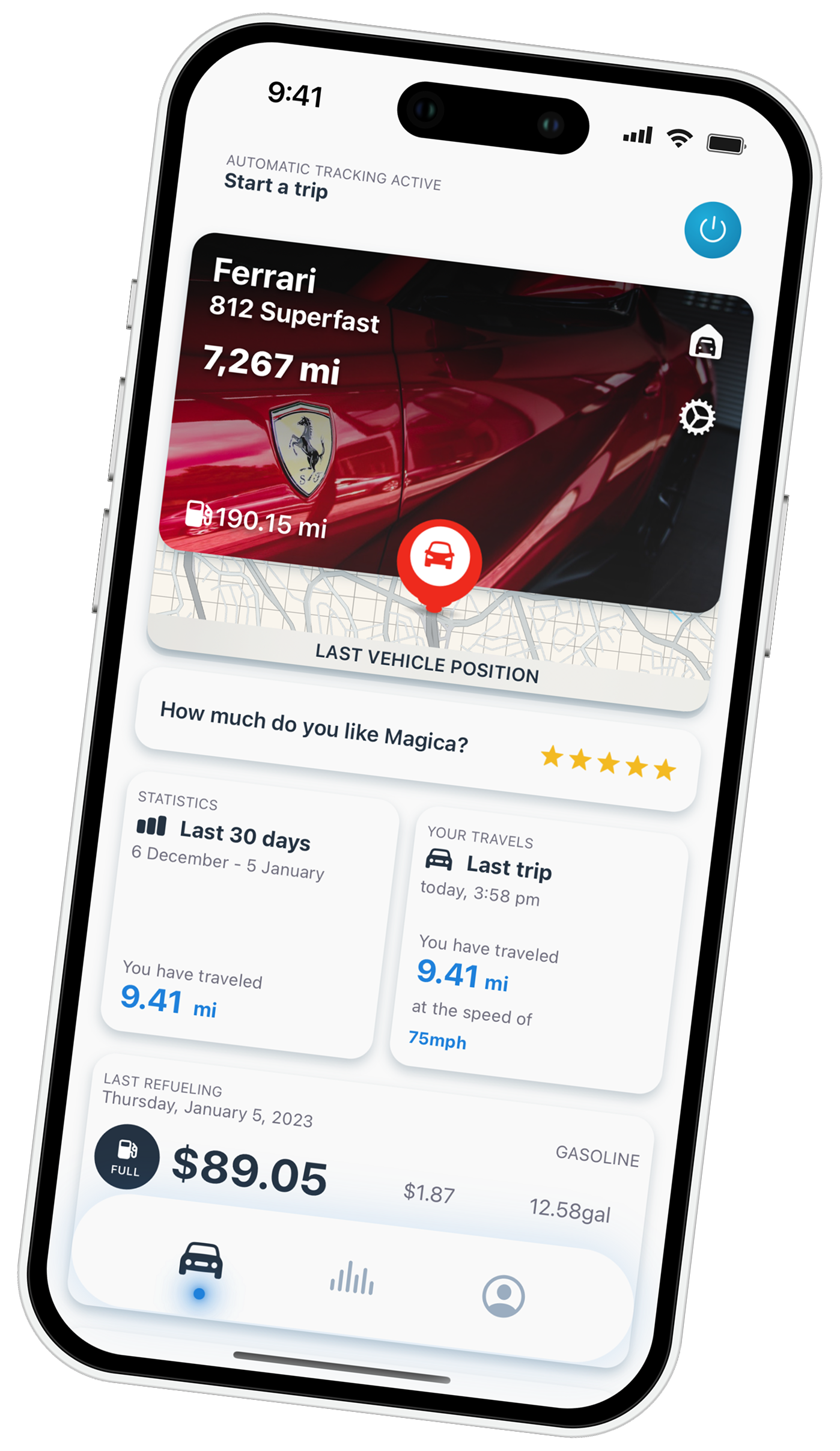
What it does not do is classify your allowance. Whether the amount on your payslip is an allowance or a reimbursement, whether it attracts super, and what your employer owes the state on it are decided by the documents quoted above, not by an app. What the app gives you is the number those documents all turn on: how far you actually drove for work.
What no allowance can tell you
Three questions decide the outcome before the allowance figure enters.
Was the trip work-related? A kilometre allowance for the commute is wages from the first cent, and no method of claiming turns it into a deduction.
How far did you drive for work in the year? Under 1,099 kilometres, the standard deduction is your deduction. Over it, the record is the deduction.
Was the allowance sized to be spent? That single expectation decides whether super is paid on it, and it is the same fact your employer’s payroll tax turns on.
The figures here are the ones the ATO, the Acts, the rulings and the award publish, and they are general. Your circumstances are not, so check them with your tax agent before you lodge — particularly this year, when the rules for the return you will lodge in 2027 changed on 26 June 2026 and most of what is written about car allowances predates that date.
Try Magica for Free
Download the app and start automatically tracking your business trips. No credit card required.
Download Now
Frequently asked questions
Is a car allowance taxable in Australia?
Yes. Section 15-2 of the Income Tax Assessment Act 1997 includes “all allowances” received in respect of employment in your assessable income, and the ATO’s car expenses page says an allowance for car expenses “must include it as assessable income in your tax return”. A payment per kilometre that your employer calls a reimbursement is also assessable, under section 15-70. You then claim your own deduction for the work-related kilometres separately.
Can I claim car expenses if I receive a car allowance?
Yes, but the allowance does not decide the amount. The ATO: “There is no automatic deduction for receiving an allowance from your employer.” You claim under Division 28 using either the cents per kilometre method at 91 cents for 2026–27, up to 5,000 work-related kilometres, or the logbook method on your work-use percentage. From 2026–27 the claim reduces the new $1,000 standard deduction dollar for dollar, so it only adds value above about 1,099 work kilometres.
Do I pay super on a car allowance?
It depends on how the allowance was sized, not on what it is called. Under the ATO’s Payday Super guidance, expense allowances “paid with the reasonable expectation that the money will be fully expended” are not qualifying earnings and attract no super guarantee; allowances that are “partial compensation” paid “regardless of whether or not the employee incurred the expense” are. The old authority, SGR 2009/2, was withdrawn on 1 July 2026 and replaced by draft LCR 2026/D1.
Is tax withheld from a car allowance?
Not from a per-kilometre payment for deductible travel at or below the ATO rate and up to 5,000 business kilometres. Tax is withheld from the part of the rate above 91 cents, from kilometres over 5,000, from any flat amount, and from all of a kilometre allowance paid for home-to-work travel, which the ATO’s table treats as gross wages.
What is the difference between a car allowance and a reimbursement?
TR 92/15: an allowance is “a definite predetermined amount to cover an estimated expense”, paid “regardless of whether the recipient incurs the expected expense”; a reimbursement compensates you “exactly” for an expense already incurred, usually against receipts. An allowance is your income; a true reimbursement is your employer’s fringe benefit and you cannot claim the expense. A reimbursement calculated per kilometre is treated as an allowance.
What is the ATO car allowance rate for 2026–27?
There is no ATO allowance rate; an employer can pay any rate the award or contract provides. The ATO figure is the deduction rate, 91 cents per kilometre for 2026–27, and it doubles as the line for withholding: payments at or below it, up to 5,000 business kilometres, have no tax withheld. The Clerks—Private Sector Award pays $1.00 per kilometre from 1 July 2026, capped at 400 kilometres a week.
What happened to award transport payments?
They were abolished. The Treasury Laws Amendment (Tax Reform No. 1) Act 2026, which received royal assent on 26 June 2026, repealed Subdivision 900-I and the definition of an award transport payment with effect for the 2026–27 income year. From 1 October 2026 employers must withhold from these payments, and the separate STP code AD cannot be used for payments made from 1 July 2027. The class existed only for allowances traceable to an award in force on 29 October 1986.
Does the $1,000 standard deduction affect my car allowance?
It affects the deduction, not the income. From 2026–27 section 25-130 gives you the lesser of $1,000 and your labour income, “reduced, but not below zero” by your Division 28 car expense deductions and other work-related claims. The allowance remains taxable in full; your car claim only improves on the standard deduction once it exceeds $1,000, which at 91 cents a kilometre means more than 1,099 work-related kilometres.




Un commento su “Car Allowance Australia 2026–27: Is It Taxable, Does It Attract Super, and Why the New $1,000 Standard Deduction Changes the Sums”
I commenti sono chiusi.