Logbook Method vs Cents per Km: How Many Kilometres You Can Really Claim in 2026–27, and Where the Two Cross Over
Almost every Australian page about car deductions tells you the same number: 5,000 kilometres, or $4,550 at the 2026–27 rate. On 31 August 2026 I pulled the Google Australia results for cents per km, cents per km ato, logbook method, how many km can i claim on tax, how many kms can you claim on tax and claiming kms on tax, took the thirty-five pages that rank and are not published by the ATO itself, and counted. Twenty-eight of the thirty-five quote the 5,000 kilometre cap.
Zero of them work out where the two methods actually cross over.
That is the whole question, and this piece answers it: logbook method vs cents per km, with the crossover calculated instead of hand-waved. The short version is that the crossover is not a distance at all. It is a cost — 91 cents a kilometre — and the arithmetic that shows why takes three lines.
I build Magica, a logbook and mileage tracker, so I have a side in this. That is also why the quotes below come from the Income Tax Assessment Act 1997 and from the ATO’s own pages rather than from other people’s summaries, with a link on each one so you can check it.
The crossover is a cost per kilometre, not a number of kilometres
Write the two methods out as formulas and they collapse into each other.
Under cents per kilometre your claim is your business kilometres times the rate — 91 cents for 2026–27 — capped at 5,000 kilometres.
Under the logbook method, section 28-90 says you “multiply the amount of each car expense by the business use percentage”, and the business use percentage is your business kilometres divided by your total kilometres. So:
logbook claim = (business km ÷ total km) × total car costs = business km × (total car costs ÷ total km)
That last bracket is your car’s cost per kilometre. Which means, below the cap, the business kilometres cancel out of both sides. The two methods pay the same when your car costs exactly 91 cents a kilometre to run. If it costs more, the logbook wins at any distance, even a thousand kilometres a year. If it costs less, cents per kilometre wins — right up to the cap.
The cap itself is worth reading in the original, because section 28-25(2) does not say “you can claim 5,000 kilometres”. It says the formula applies “for the first 5,000 business kilometres only. If the car travelled more than 5,000 business kilometres, you must discard the kilometres in excess of 5,000”, and the Act supplies its own example: “If the car travelled 5,085 business kilometres, you could claim for 5,000, and would lose the extra 85.” Those eighty-five kilometres are not carried anywhere. None of the thirty-five pages quotes that example, which is a shame, because it is the clearest statement of what the cap is: a ceiling on one calculation, not a quota you are allowed.
Past the cap the comparison changes shape, because cents per kilometre freezes at $4,550 while the logbook keeps climbing. So for a car that runs cheaper than 91 cents, the logbook overtakes at exactly $4,550 ÷ your cost per kilometre:
| If your car costs… | The logbook overtakes at… |
|---|---|
| 50c per km | 9,100 business km |
| 60c per km | 7,583 business km |
| 70c per km | 6,500 business km |
| 80c per km | 5,688 business km |
| 91c per km | 5,000 business km — exactly the cap |
| more than 91c per km | immediately, at any distance |
Two numbers decide it, then: what your car costs per kilometre, and whether you drive past the cap. Twenty-eight of the thirty-five pages have the second one. None of them has the first.
Why 91 cents is the number and not some other one
Because the Act says the rate has to be an average of what cars cost to run.
Section 28-25(4) lets the Commissioner “by legislative instrument, determine rates of cents per kilometre for cars for an income year”, and subsection (5) constrains the choice: “In determining a rate, the Commissioner must have regard to the average operating costs for the cars to be covered by that rate.” The note spells out what counts — “fixed costs such as registration, insurance and depreciation, and variable costs such as fuel and maintenance”.
None of the thirty-five pages mentions that subsection, and it is the one that makes the whole comparison legible. Cents per kilometre is, by design, roughly break-even for an average car. It pays when your car is cheaper to run than average — an old paid-off hatchback, a small car with low rego and no finance — and it costs you when your car is dearer than average, which usually means new, financed, thirsty, or all three.
The current rate lives in the Income Tax Assessment (Cents per Kilometre Deduction Rate for Car Expenses) Determination 2026 — F2026L00785, registered and effective on 23 June 2026, repealing the 2024 one. The ATO’s own list of rates runs 72 cents for 2020–21 and 2021–22, 78 cents for 2022–23, 85 cents for 2023–24, 88 cents for 2024–25 and 2025–26, and 91 cents for 2026–27: five different rates across seven income years. Use the rate for the year you are claiming, not the one you read about last year.
The 91 cents is itself two numbers — a base of 89 indexed to the CPI and a one-off 2-cent uplift for the 2026–27 year only — and the return you lodge this spring still uses 88. How the ATO km rate is set, and which year’s rate you use goes through the instrument and its explanatory statement.
What each method costs you in paperwork
This is the trade the Act is actually offering, and it is stated in two short sections.
Section 28-35 is one sentence long: “To use this method, you do not need to substantiate the car expenses for the car.” No receipts, no invoices, no fuel dockets. The ATO says it in plainer words — you “don’t need receipts for your expenses (e.g. fuel receipts)”.
Section 28-100 is the other side: “To use this method, you must substantiate the car expenses under Subdivision 900-C”, plus a logbook, plus odometer records for the whole period you held the car.
But “no receipts” is not “no records”, and only three of the thirty-five pages say so clearly. Cents per kilometre still requires “a record to show how you calculate your work-related kilometres (e.g. using a diary or the myDeductions tool in the ATO app)”, and section 28-25(3) is explicit that the number is an estimate: “You calculate the number of business kilometres by making a reasonable estimate.”
The ATO’s own worked example shows what a reasonable estimate looks like. Johan drives a 27-kilometre round trip once a week and a 106-kilometre round trip once a month. He was at work 47 weeks, missed one weekly meeting, and still made twelve monthly trips: 46 × 27 + 12 × 106 = 2,514 kilometres. That is a pattern multiplied by a count, written down at the end of the year, and it is enough. What is not enough is a number with nothing behind it.
The logbook method does not need fuel receipts either
This one surprises people, and only five of the thirty-five pages mention it. The ATO’s list of records you must keep under the logbook method starts with:
receipts for your fuel and oil expenses, or a record of your reasonable estimate of these expenses based on the odometer readings for the start and end of the period you owned the car, the fuel consumption for your car and the average price of fuel during the income year
So the servo docket, the most annoying receipt of the lot, is optional under either method. Everything else is not: rego, insurance, lease payments, services, tyres, repairs, electricity, interest charges, and a record of the purchase price and how you worked out decline in value.
If your car is electric, the equivalent shortcut is a published rate: instead of proving what a charge in your own garage cost, you multiply kilometres by the EV home charging rate. Three of the thirty-five pages mention it, and here the numbers are worth checking twice.
The ATO’s logbook method page, last updated 12 June 2026, says “the EV home charging rate for the 2022–23 to 2025–26 income years is 4.2 cents per kilometre”. That is true, and it stops one year short. Practical Compliance Guideline PCG 2024/2 was updated on 25 March 2026 and its Table 2 now carries two rates: 4.20 cents per kilometre for a “fringe benefits tax year or income year commencing on and after 1 April 2022”, and 5.47 cents per kilometre for one “commencing on and after 1 April 2026”. The 2026–27 income year started on 1 July 2026, so the rate for the year you are living in is 5.47 cents — a 30% rise, set out in a guideline rather than on the page most people land on. One of the thirty-five pages has the new figure.
The footnote explains where it comes from, which is more transparency than the flat car rate gets: it is “based on the top 40 selling electric vehicles (July 2021–June 2025), electrical consumption rates (watt hours per km) from the Green Vehicle Guide, and the Australian Energy Market Commission National Electricity Market national average cents per kilowatt hour”. If you want the underlying costs rather than the shortcut, I have written separately about what charging actually costs at home versus in public.
The number that usually settles it: decline in value
Here is the ATO’s own example, which is more persuasive than anything I could construct.
Lana buys a five-seater for $75,000 in July 2025. The car limit caps her depreciable cost at $69,674, effective life eight years, diminishing value: $69,674 × (362 ÷ 365) × (200% ÷ 8) = $17,275.33 of decline in value for the year. Her logbook says 69% work use: $17,275.33 × 69% = $11,919.98 — and that is before a litre of fuel, a tyre or a rego sticker.
Set that against the entire ceiling of the other method. The most cents per kilometre can ever produce is 5,000 × $0.91 = $4,550. Lana’s depreciation alone is two and a half times the whole thing.
Then the sentence the ATO puts at the bottom of the same page: “You can’t claim a deduction for the decline in value of your car if you use the cents per kilometre method.” The rate already contains it — “The rate per km covers all of your car expenses including decline in value, registration and insurance, maintenance, repairs and fuel costs. You can’t add these, or any other car expenses, on top of the rate.”
That is why the practical rule of thumb — new or expensive car, keep the logbook; old cheap car driven occasionally, take the rate — is usually right. It is right because of depreciation, not because of distance.
The mirror image is on the same ATO page. Vlad buys a $30,000 electric car and his logbook gives him 11% work use. Prime cost, eight-year effective life, and the ATO works it out for him: he can claim a deduction of $413 ($3,750 × 11%). For Vlad the twelve weeks of paperwork are almost certainly not worth it.
The 5,000 kilometre cap is per car, and per owner
Two details that get lost when the cap gets quoted as a personal allowance.
It is per car. The ATO: “You can claim a maximum of 5,000 work-related kilometres per car.” Two cars, two caps. And section 28-20(3) lets you mix: “You can also choose different methods for the same car for different income years and different methods for different cars for the same year.” Two of the thirty-five pages say this. So the ute you thrash can run on a logbook while the second car takes the flat rate, in the same year, on the same return.
It is per owner, too. From the ATO’s cents per kilometre page: “If you and another joint owner use the car for separate income-producing purposes, you can each claim up to 5,000 work-related kilometres.” Two of the thirty-five pages mention it. If you and a partner both run businesses out of the same car, that is $9,100 of ceiling rather than $4,550.
If you do go the logbook route on more than one car, the ATO adds a scheduling constraint most people discover too late: “If you are using the logbook method for 2 or more cars, keep a logbook for each car and make sure they cover the same period.” Two logbooks, same twelve weeks, not one after the other.
You are allowed to change your mind — the Act says so, with an audit example
This is the fact I most wanted someone else to have written, and nobody has. Not one of the thirty-five pages contains the phrase.
Section 28-20(1) is the rule everyone knows: “You can choose only one method for all the car expenses for the car for the income year. Choosing one method precludes the other method.” Then subsection (2):
However, you can change your choice for the income year.
>
Example: You choose the “log book” method and deduct $1,000. On audit, the Commissioner finds that your claim is too high and should be reduced to $500. You would have been able to deduct $700 if you had chosen the “cents per kilometre” method. This rule lets you change your choice and deduct the $700.
Read what that example is describing. You picked the logbook, it did not hold up under review, and the Act hands you the other method as a floor rather than leaving you with the reduced number. The choice is not a trapdoor.
Which has a practical consequence for anyone hesitating at the end of August: starting a twelve-week logbook now costs you nothing you cannot recover. If the percentage turns out worse than the flat rate, you take the flat rate. If your records turn out thinner than you hoped, the fallback is written into the same section. The ATO says the same thing about invalid logbooks from the other direction: “If you don’t have a valid logbook, you can’t use the logbook method to claim car expenses. You may be able to use the cents per kilometre method instead.”
The catch that only shows up when you sell the car
“Just run both numbers each year and pick the bigger one” is common advice, and it is nearly right. The part it leaves out is section 40-370, which two of the thirty-five pages name and neither explains.
When you dispose of a car, a balancing adjustment normally happens under section 40-285. Section 40-370 replaces it with a different calculation if you deducted decline in value in some years and chose cents per kilometre in others. The two notes under it are the clearest statement of the consequence:
Note 1: This means if you have only used the “log book” method since you began using the car, you calculate the assessable amount or deductible amount under section 40-285.
>
Note 2: Also, if you have only used the “cents per kilometre” method since you began using the car, no amount is assessable or deductible under this section or section 40-285.
Stay on one method for the life of the car and disposal is simple — under the logbook, the ordinary rules; under the flat rate, nothing at all. Alternate between them and a third set of rules applies on the day you sell. It is not a reason to avoid switching. It is a reason to ask your tax agent what the switch costs at the other end, before you save a couple of hundred dollars this year.
The third document, and the estimate that has to move
Two more obligations under the logbook method that the thirty-five pages between them barely touch.
Section 28-100(4): “You must record the following information, in writing, before you lodge your income tax return: (a) your estimate of the number of business kilometres; and (b) the business use percentage.” That is a third document, separate from the logbook and the odometer records, and it has a deadline attached — before lodgement, not at some point afterwards when a query arrives.
Section 28-90(5): the estimate “must take into account all relevant matters, including … any variations in the pattern of use of the car; and … any changes in the number of cars you used in the course of producing your assessable income.”
That is the sentence that stops a logbook from being a five-year licence to reuse one number. Your percentage carries forward for five years only while it still describes your driving. Change jobs, move house, add a second car to the business, lose a big client whose site was an hour away — and the Act asks you to adjust rather than repeat. Two of the thirty-five pages get near this. It is also the rule that quietly decides most disputes, because a percentage from 2022 applied unchanged to 2026 is the easiest thing in the world to question.
When neither method is available
Section 28-12(2) is blunt about the stakes: “You must use one of the 2 methods unless an exception applies. If you can’t use either of the methods, you can’t deduct anything for the car expenses.” None of the thirty-five pages quotes it.
The exception that catches people is section 28-165, “Exception for particular cars taken on hire”: “For particular types of cars taken on hire you cannot use one of the 2 methods.” Subsection (3): “This section applies to a taxi taken on hire.” Subsection (4) extends it to a vehicle hired “on an hourly, daily, weekly or short term basis” — car-share and rental, in other words — unless successive hire agreements add up to “substantial continuity”. In that case, subsection (2), “you must calculate the deductions under the normal principles governing deductions”. Not nothing: just not these two methods. Nobody in the thirty-five pages mentions it, and it is exactly the situation a contractor who hires a van for a fortnight ends up in.
There are three more exits — a vehicle that is not legally a “car”, a work ute with only minor private use, and a car you neither own nor lease — and I have written them up with the sections in the piece on ATO logbook requirements.
Why the old advice you half-remember is wrong
If someone once told you the rate depends on your engine size, they were right, and it stopped being true eleven years ago.
The pre-2015 version of section 28-25(1) read: you multiply the business kilometres “by: a number of cents based on the car’s engine capacity. The number of cents can be found in the regulations.” Act No 162 of 2015 replaced that with a single rate for all cars, and cut the number of methods from four to two — the “12% of original value” and “one-third of actual expenses” methods went. You can still see the seam in the Act: section 28-165 carries a history note recording that it was amended by substituting “2 methods” for “4 methods”.
The same amendment set the opening rate by transitional provision: “the rate of 66 cents per kilometre for all cars for the 2015-16 income year”. From 66 cents to 91 cents is a 37.9% rise in eleven income years. Six of the thirty-five pages know there used to be four methods. Rather more of the internet is still repeating advice built on them.
How to decide, in one evening
- Find your total kilometres for last year. Two odometer readings, twelve months apart. If you do not have them, this is the year to start writing them down.
- Add up what the car cost you. Fuel or charging, rego, insurance, servicing, tyres, repairs, interest if it is financed, and depreciation if you own it. Bank and card statements will get you most of the way in half an hour.
- Divide. Costs ÷ total kilometres = your cost per kilometre. Compare it to 91 cents.
- Estimate your business kilometres. Pattern times count, the way Johan did.
- Read the table above. Above 91 cents a kilometre, the logbook wins whatever your distance. Below it, the logbook wins only once you pass $4,550 ÷ your cost per kilometre.
- If it is close, keep the logbook anyway. Twelve weeks of records let you claim either way; no records let you claim one way. Section 28-20(2) is the safety net, and it only helps people who have the option to change.
The ATO also publishes a work-related car expenses calculator that will run both methods for you once you have the inputs. The inputs are the hard part, which is the whole reason a logbook app exists.
One input the calculator will not ask you for, and neither method covers: the tolls and parking you paid on the way. They are deductible, but the ATO does not treat them as car expenses at all — which trips and which costs actually count goes through that list, and through the trips that decide whether any of it is claimable.
Where Magica fits, and where it does not
Steps 1 to 3 of that list are the entire product problem. The number that decides your method is your car’s cost per kilometre, and almost nobody knows theirs, because the odometer lives in the car and the costs live in a bank statement.
Trips and odometer readings are kept apart, the way the Act keeps them. Detection is automatic by motion and Bluetooth, classifying a trip Work or Personal is a swipe, and odometer readings belong to the vehicle rather than to a trip — you can update one by voice from the driveway.
Fuel, charging, servicing and rego live in the same app as the kilometres. Fill-ups and charges are logged with their cost, servicing goes in the maintenance history, receipts can be scanned and kept, and rego and insurance renewals are reminders rather than surprises. That is the numerator of step 3, sitting next to its denominator.
Reports export as PDF or CSV for your tax agent, with the business-use percentage worked out as you go, so a logbook year and a cents-per-kilometre year both come out of the same records. Which matters more than it sounds, given that section 28-20(2) lets you change your mind after the year has ended.
Your records stay on your device. There is no Magica account and no server of mine holding your trips: everything is on-device and encrypted, and on iPhone the backup goes to your own iCloud. iOS and Android sync, so a new handset mid-logbook does not orphan the period.
What it does not do: decide for you, or file anything. It is a record, not a tax agent. If you are collecting logbooks from a crew you want a proper fleet setup with a back office, which by design is not what an on-device app is. And I have written honestly about which logbook app suits which situation, including where the ATO’s own free myDeductions beats me.

Try Magica for Free
Download the app and start automatically tracking your business trips. No credit card required.
Download Now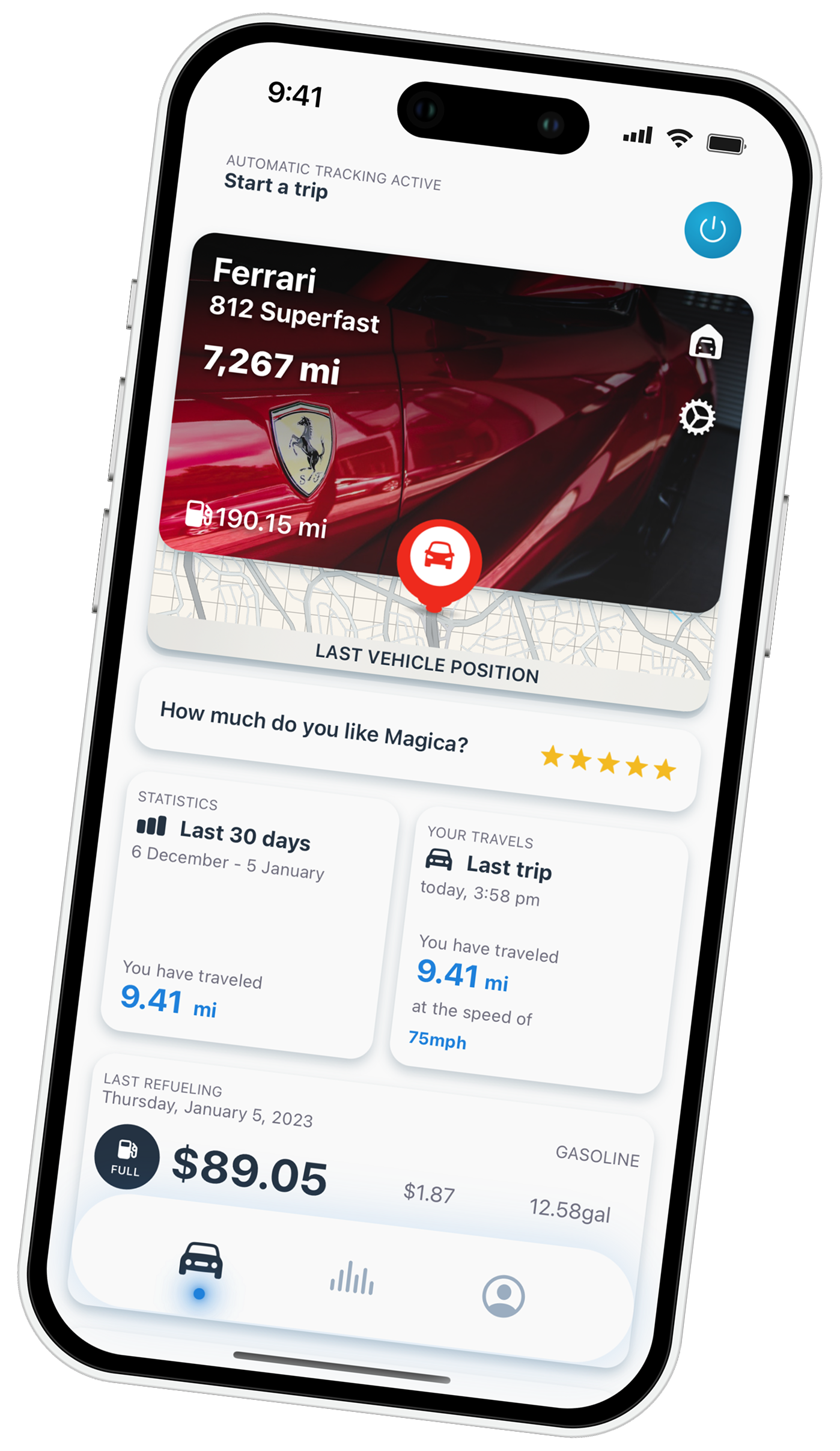
What no app can tell you
Whether your twelve weeks were representative. The ATO wants a logbook that is “broadly representative of your travel” — that phrase is the ATO’s, not the Act’s, which is part of why it gets argued about. Pick your busiest quarter and the percentage flatters you, and no software knows that your March is not your November.
What switching methods costs when you sell. Section 40-370 is a conversation with a registered tax agent, not a toggle in a settings screen.
Whether a trip was work. Tracking software knows where you went. Only you know why, and “why the journey was made” is the field a reviewer actually reads.
Tax information here is general and current at 31 August 2026. Rates, thresholds and rulings change — check your own situation with a registered tax agent before you lodge.
Frequently asked questions
How many kms can you claim on tax in Australia?
Up to 5,000 business kilometres per car per year under the cents per kilometre method, which at the 2026–27 rate of 91 cents is a maximum of $4,550. Under the logbook method there is no kilometre cap at all: you claim the business-use percentage of your actual car costs, including decline in value. So the 5,000 figure is a limit on one method, not a limit on you.
Is the logbook method or cents per km better?
It depends on one number: what your car costs per kilometre to run. Below the 5,000 kilometre cap the two methods pay the same when that cost equals the rate — 91 cents for 2026–27 — because the business kilometres cancel out of both calculations. Above 91 cents a kilometre the logbook wins at any distance. Below it, the logbook only wins once your business kilometres pass $4,550 divided by your cost per kilometre.
Can I change from cents per km to the logbook method?
Yes. Section 28-20(1) of the Income Tax Assessment Act 1997 says you can use only one method for a car in an income year, but subsection (2) adds: “However, you can change your choice for the income year.” The Act’s own example covers a claim reduced on audit, where the taxpayer switches to the other method and keeps the larger of the two remaining amounts. You can also use different methods for different cars in the same year.
Do I need receipts for the cents per kilometre method?
No. Section 28-35 says “you do not need to substantiate the car expenses for the car”, and the ATO confirms you do not need fuel receipts. You do still need a record showing how you worked out your work-related kilometres — a diary or the myDeductions tool in the ATO app — because the kilometres are a reasonable estimate under section 28-25(3), and an estimate needs a basis.
Do I need fuel receipts for the logbook method?
Not necessarily. The ATO accepts either receipts for fuel and oil, or a record of your reasonable estimate based on your odometer readings, your car’s fuel consumption and the average price of fuel over the income year. Receipts are still required for the other expenses — registration, insurance, servicing, tyres, repairs, lease payments and interest — and for working out decline in value.
Can two people each claim 5,000 kilometres on the same car?
Yes, if they are joint owners using the car for separate income-producing purposes. The ATO’s cents per kilometre page states that in that case “you can each claim up to 5,000 work-related kilometres”, which is $9,100 of combined ceiling for 2026–27 rather than $4,550.
What is the ATO cents per kilometre rate for 2026–27?
91 cents per kilometre, set by the Cents per Kilometre Deduction Rate for Car Expenses Determination 2026 (F2026L00785), registered on 23 June 2026. The rate applies to the whole income year and covers every car expense, including decline in value, registration, insurance, maintenance, repairs and fuel. Earlier years were 88 cents for 2024–25 and 2025–26, 85 cents for 2023–24, 78 cents for 2022–23 and 72 cents for 2020–21 and 2021–22.
What happens if I use neither method?
Section 28-12(2) is explicit: “You must use one of the 2 methods unless an exception applies. If you can’t use either of the methods, you can’t deduct anything for the car expenses.” The exceptions run the other way — for example, section 28-165 says cars taken on hire on an hourly, daily, weekly or short-term basis, and taxis, fall outside both methods and are claimed under the ordinary deduction rules instead.



5 commenti su “Logbook Method vs Cents per Km: How Many Kilometres You Can Really Claim in 2026–27, and Where the Two Cross Over”
I commenti sono chiusi.