ATO Logbook Requirements in 2026–27: What Division 28 Actually Says, and the Seven Rules Almost Nobody Quotes

On 28 August 2026 I pulled the Australian search results for ato logbook requirements and for ato logbook, took the seventeen pages that rank and are not published by the ATO itself, and read all of them against the law they are describing.
Fifteen of the seventeen tell you the logbook has to run for twelve continuous weeks. Twelve tell you it lasts five years. Fourteen explain the business-use percentage. That part of the internet is in good shape, and if that is all you needed you can stop reading.
But the requirements themselves are not in a blog post and they are not on the ATO website either. They are in **Division 28 of the Income Tax Assessment Act 1997, in sections short enough to read over a coffee, and the Act is both stricter and more forgiving than its summaries. Seven rules below are missing almost everywhere: four appear in zero** of those seventeen pages, three more in exactly one.
I build Magica, a logbook and mileage tracker, so I have a side in this. That is also why I read the Act instead of the summaries: an app that produces a logbook has to satisfy the section, not the paraphrase. Every quote below is linked to its source so you can check it.
The three steps, in the Act’s own words
Section 28-110 is the whole method in three lines. It says:
There are 3 steps you need to follow in keeping a log book:
– identify an income year for which to keep a log book;
– choose a period of at least 12 weeks for the log book to cover;
– record journeys made in the car during the log book period in the course of producing your assessable income.
Read the third one again. Journeys made in the course of producing your assessable income. Not every journey. That distinction runs through everything below, and it is where most of the confusion starts.
What has to be in each entry
Section 28-125(2) lists four things, and only four:
(a) the day the journey began and the day it ended;
(b) the car’s odometer readings at the start and end of the journey;
(c) how many kilometres the car travelled on the journey;
(d) why the journey was made.
Then the sentence that decides whether your logbook survives a review:
The record must be made at the end of the journey or as soon as possible afterwards.
The ATO’s logbook method page says the same thing in plainer words and adds the destination: your logbook must “include the reason and purpose, as well as the destination of every work-related journey, the odometer reading at the start and end of each journey, and the total kilometres travelled on the journey”.
Two details in paragraph (a) that the summaries flatten. First, the Act wants the day it began and the day it ended — two dates, not one. For a day trip they are the same date and nobody notices; for a country run that finishes the next morning they are not, and a form with a single date field cannot express it. Exactly one of the seventeen pages I read spells this out.
Second, “why the journey was made” is a free-text field with no minimum. The ATO expects a purpose you could defend, not a category. “Work” is not a purpose. “Quote, 14 Rundle St” is.
The five entries for the period itself
A logbook is not only a list of trips. Section 28-125(4) requires five more entries about the period as a whole:
(a) when the log book period begins and ends;
(b) the car’s odometer readings at the start and the end of the period;
(c) the total number of kilometres that the car travelled during the period;
(d) the number of kilometres that the car travelled, in the course of producing your assessable income, on journeys recorded in the log book;
(e) the number of kilometres referred to in paragraph (d), expressed as a percentage of the total number referred to in paragraph (c).
Line (c) is where your private kilometres come from, and it is the answer to the question people ask most: no, you do not have to write down your private trips. The total for the period comes off the odometer. The business kilometres come from the entries. The difference is private, and the Act never asks you to itemise it.
What section 28-125(1) says instead is gentler and sharper at the same time:
It is in your interests to record in the log book any journey made in the car during the log book period in the course of producing your assessable income. If a journey is not recorded, the log book will indicate a lower business use percentage than is actually the case.
That is not an obligation. It is an explanation of who gets hurt. Miss a work trip and you do not get fined — you get a smaller deduction, every year for five years.
And one requirement that reads like a typo until you notice it is a rule: section 28-125(5), “Each entry in the log book must be in English.” One page of the seventeen mentions it. If you keep notes in another language, they have to be in English by the time the logbook is a logbook.
Two or more trips in a row on the same day count as one
This is section 28-125(3), quoted in full:
If 2 or more journeys in a row are made in the car on the same day in the course of producing your assessable income, they can be recorded as a single journey.
A sparky doing six calls between eight and four does not need six entries. One entry — first odometer reading of the morning, last of the afternoon, one purpose line covering the run — is what the Act allows. Two of the seventeen pages mention this. It is the single biggest reduction in paperwork available in the whole method, and it is sitting in a one-sentence subsection.
The trade-off is real, so decide it deliberately: one entry is less typing and a weaker record. If two of those six calls were for a different client, or one leg was private, the merged entry hides it. I would merge a genuine run of jobs and split anything that crosses a boundary you might have to explain later.
The twelve weeks: three rules that are not where you would look
Section 28-120 does the period, and all three of its subsections matter.
It must be continuous, and you must hold the car throughout. “The log book must cover a continuous period of at least 12 weeks throughout which you held the car.” Twelve weeks is 84 days. Miss the middle three and you do not have an 84-day logbook, you have two shorter ones.
If you held the car for less than twelve weeks, the period is however long you held it. Same subsection: “If you hold the car for less than 12 weeks, the period must be the entire period for which you held the car.” Buy a work car in May and you are not locked out of the method for that year.
It can straddle the end of the financial year. Subsection (2): “The period may overlap the start or end of the income year, so long as it includes part of the year.” Two of the seventeen pages say this, and it is the most immediately useful rule on this page. If you are reading this in late August and think you have missed your run at 2026–27, you have not: a period that starts now finishes in November, sits entirely inside the income year, and is valid. A period that started in May and finishes in August is also valid, for both years it touches part of.
And if you run two cars, the periods have to line up. Subsection (3): “If you want to use the ‘log book’ method for 2 or more cars for the same income year, the log books for those cars must cover periods that are concurrent.” Not two logbooks whenever it suits — two logbooks running side by side over the same weeks.
Odometer records are a second document, and they want the engine
Almost everyone treats the odometer readings as part of the logbook. The Act puts them in their own Subdivision, 28-H, because they are a separate record with separate contents. Section 28-140(3) requires the document to state:
(a) the car’s make, model and registration number (if any);
(b) if the car has an internal combustion engine — its engine capacity expressed in cubic centimetres
Three of the seventeen pages mention engine capacity at all. Note the condition: “if the car has an internal combustion engine”. A fully electric car has no engine capacity to state, and the Act does not ask for one. That conditional was written long before anyone was claiming a work-related EV, and it happens to have aged correctly.
Your rego belongs in the record too, which is a small thing until you change plates mid-period.
How long a logbook lasts — and why the ATO published a page saying it does not
Twelve of the seventeen pages say the logbook is valid for five years. So does the ATO: “Your logbook is valid for 5 years.” The Act says it slightly differently, and the difference is useful. Section 28-115(2):
Having kept a log book for one income year, you don’t need to keep a new one for the next 4 or more income years unless subsection (3) or (4) requires it. If you haven’t kept a new log book for 4 income years in a row, you must keep one for the next income year.
One year on, four years off, then one on again. In the four off years you still keep something: the ATO wants “odometer readings for the start and end of the full period you owned the car during the income year” plus your work-related kilometres and percentage for that year.
Now the part the five-year headline hides. The ATO has its own page for tax agents titled It’s logbook check-in time, updated 17 April 2026, and its opening line is:
Logbooks don’t always last for 5 years.
It then lists when a new one is needed: the client “changes jobs”, “moves to a new house or workplace”, or has “changes to their pattern of use of the car for work purposes”. The logbook has to stay “broadly representative of your travel”, and a new job or a house move is usually enough to break that.
Eight of the seventeen pages do cover this, so it is not a secret. What is odd is the shape of it: the same pages lead with “valid for five years” and then walk it back three paragraphs later, while the ATO — which ranks in the top ten for the exact search you probably used to get here — leads with the walk-back. If you only remember one of the two sentences, remember theirs.
Two more triggers come straight from the Act, and neither appears in any of the seventeen pages.
Section 28-115(3): the Commissioner can order you to keep one. “You must keep a log book for an income year if the Commissioner sends you a notice before the year directing you to keep a log book for the car for that year.” A logbook is not always your choice.
Section 28-115(4): buying an extra car forces one. “You must keep a log book for an income year if, during that year, you get one or more additional cars for which you want to use the ‘log book’ method for that year.” Add a second work vehicle in March and your existing logbook stops carrying you for that year.
Replacing a car is not the same as adding one
This is the question people actually have, and the answer turns on a word.
If the new car replaces the old one, section 28-130 lets you carry the old logbook across. You “may nominate one car as having replaced another car with effect from a day specified in the nomination”, and after that “the replacement car is treated as the original car”, so “you do not need to repeat for the replacement car the steps you have already taken”. No new twelve weeks.
The nomination is not automatic and it is not a thought. Subsection (3): “You must record the nomination in writing before you lodge your income tax return for the income year in which the nomination takes effect.” The ATO’s check-in page, written for tax agents, says what the writing has to state: that the taxpayer is “replacing their original car with a new car”, and “the date that nomination takes effect”. Keep that piece of paper as long as you keep the logbook — section 28-130(4) says so explicitly.
If the new car is an addition rather than a replacement, subsection 28-115(4) above applies and you are keeping a new logbook. Same driveway, same year, opposite answer.
The retention rule is longer than everyone thinks
The ATO’s plain-English version: “You must retain your logbook and odometer records for 5 years after the end of the latest income year that you rely on them to support your claim.”
Section 28-150 says it with the clock started properly:
You must retain the log book: (a) first, until the end of the latest income year for which you rely on the log book to support your calculation of the business use percentage for the car; and (b) then for another 5 years.
The 5 years start on the due day for lodging your income tax return for that latest income year. If you lodge your return later, the 5 years start on the day you lodge it.
Put a calendar against it. Start a logbook in September 2026, inside the 2026–27 income year, and rely on it for the full run through 2030–31. That is the latest year you rely on it. The due date for lodging your own return is 31 October, so the five years start on 31 October 2031 and run to 31 October 2036. Through a registered tax agent the lodgement date can be as late as 15 May of the following year, which pushes the end of the retention period out with it.
Twelve weeks of typing in spring 2026 has to still be readable in spring 2036. Ten years and two months. And note that the ATO’s summary — five years after the end of the income year — lands on 30 June 2036, four months earlier than the Act does. If you throw records out on the summary’s date you are throwing them out early.
Section 28-150(4) is blunt about the consequence:
If you do not retain the log book for the retention period, you cannot deduct any amount worked out using a business use percentage that you are relying on the log book to support. If you have already deducted such an amount, your assessment may be amended to disallow the deduction.
Not “you may be asked for it”. The deduction goes, retrospectively, for every year it supported. This is the reason I think the storage question matters more than the feature list when you pick where to keep a logbook — the file has to outlive two phones and probably a laptop.
When you do not need a logbook at all
Three exits, and the first two are missed constantly.
Your vehicle might not be a car. The Act’s definition is a size test: a car is “a motor vehicle (except a motor cycle or similar vehicle) designed to carry a load of less than 1 tonne and fewer than 9 passengers”. The ATO’s small business guide puts it the same way and adds the practical translation: “Many four-wheel drives and some utes are classed as cars”, while “utes or panel vans designed to carry loads of one tonne or more” are an ‘other vehicle’. If yours is an ‘other vehicle’, Division 28 does not apply — neither the logbook method nor cents per kilometre — and you claim the business portion of actual costs under the ordinary rules instead. You still need records; you just do not need this record. One of the seventeen pages mentions the definition.
A work ute with barely any private use may be exempt anyway. Section 28-170 lists cars you do not need to use either method for. The first item covers “a panel van or utility truck” or “any other road vehicle designed to carry a load of less than 1 tonne”, where the only uses during the year were work travel, travel between home and a work site, incidental travel — and “your own or someone else’s private use that was minor, infrequent and irregular”. None of the seventeen pages mentions this. It is not a licence to skip records, and “minor, infrequent and irregular” is a test you would have to be able to demonstrate. But it is in the Act, and it is worth asking your tax agent about before committing to twelve weeks.
A car you do not own or lease is out. The ATO’s check-in page: if “your client’s employer provides them with a car or they salary sacrifice a car using a novated lease, they aren’t entitled to claim work-related car expenses using the logbook or cents per kilometre method. This is because they don’t own the car.”
The exception to that exception is worth knowing: a car owned by a family member can still be yours for tax if you can show a private arrangement that made you the owner, registration papers notwithstanding. That rule, and the rest of what counts as a work-related car expense, sits outside the logbook rules.
The ATO is blunt about what happens if none of these exits apply and your logbook does not hold up: “If you don’t have a valid logbook, you can’t use the logbook method to claim car expenses. You may be able to use the cents per kilometre method instead.” The fallback exists, but it is capped — see below — while a logbook claim has no ceiling at all. Which of the two actually pays more is a separate calculation, and it turns on one number: I have worked out where the logbook method and cents per kilometre cross over, and it is not 5,000 kilometres.
That ordinary alternative: cents per kilometre. For 2026–27 the rate is 91 cents per kilometre. Section 28-25(2) caps it: “you can use this formula for the first 5,000 business kilometres only. If the car travelled more than 5,000 business kilometres, you must discard the kilometres in excess of 5,000.” The ceiling is therefore 5,000 × $0.91 = $4,550, and you cannot claim decline in value on top. You still need a record of how you worked out the kilometres — the method drops the receipts, not the arithmetic.
If your employer pays you a kilometre rate on top of your wages, the record matters twice: once for your own deduction, and once for your employer, whose payroll tax exemption is built on the same business kilometres. That side of it — allowance against reimbursement, withholding, super — is in car allowance in Australia.
That rate is a single number for a single income year, and it is the year of the driving that decides it, not the year of the lodgement: the 2025–26 return still uses 88 cents. The mechanism behind the figure — the CPI series, the 89-cent base and the 2-cent uplift — is in ATO km rate 2026–27.
The twelve-week checklist
If you are starting a logbook this week, this is the whole job.
- Read the odometer today and write the number down with the date. That is entry (a) and (b) of section 28-125(4).
- Note the car’s make, model, rego and — if it burns fuel — engine capacity in cc. That is the odometer record under section 28-140.
- Pick your 84 days and put the end date in your calendar now. It may cross 30 June.
- Log every work trip as it ends: start and end day, odometer at both ends, kilometres, and why. In English.
- Merge a run of same-day jobs into one entry if that is honestly what it was.
- Ignore your private trips. They come out of the odometer subtraction.
- Read the odometer on the last day and work out the percentage: business kilometres divided by total kilometres.
- Keep the receipts for fuel, servicing, rego, insurance, tyres, interest and your decline-in-value working. The logbook gives you the percentage; the receipts give you the amount it applies to.
- File the whole thing somewhere you will still have access to in 2036, and diarise a check each year: still the same job, same house, same driving pattern?
Step 9 is the one that decides which tool you should be using, and it is worth thinking about before step 1 rather than after step 8. I have written a longer piece on how to choose a mileage app that starts from the same place.
Where Magica fits, and where it does not
I built Magica around the storage half of that list rather than the tracking half, because the tracking half is a solved problem and the storage half is the one that fails ten years later.
Trips are logged as they happen, on the phone. Detection is automatic by motion and Bluetooth, each trip carries its own start and end, and classifying it Work or Personal is a swipe. The purpose line stays yours to write — see the next section for why that is not a gap I am apologising for.
Odometer readings belong to the vehicle, not to a trip, which mirrors the way the Act splits them into two documents. You can update one by voice while you are still in the driveway — “update the odometer to 85,000 km” — so the readings for the start and end of a period are a lookup, not an archaeology project.
Two vehicles keep two logbooks over the same weeks. The garage is unlimited and Auto Switch works out which car you are in over Bluetooth or audio, which is section 28-120(3) handled by the thing that already knows.
Your records stay on your device and still get backed up. There is no Magica account and no server of mine holding your trips: everything is on-device and encrypted, and on iPhone the backup goes to your own iCloud automatically. iOS and Android sync, so replacing a handset mid-period does not orphan a logbook.
Reports export as PDF or CSV for your tax agent, ready for either method, with the business-use percentage worked out as you go. And because it tracks the rest of the car too — fuel and charging, servicing, rego and insurance reminders — the receipts side of the checklist lives in the same place as the kilometres.
What it does not do: fleet administration. There is no central console for approving other people’s logs, by design, because there is no central anything. If you are collecting logbooks from a crew you want something with a back office and a proper fleet setup, and I have written honestly about which logbook app fits which situation — including where Driversnote and the ATO’s own myDeductions beat me.

Try Magica for Free
Download the app and start automatically tracking your business trips. No credit card required.
Download Now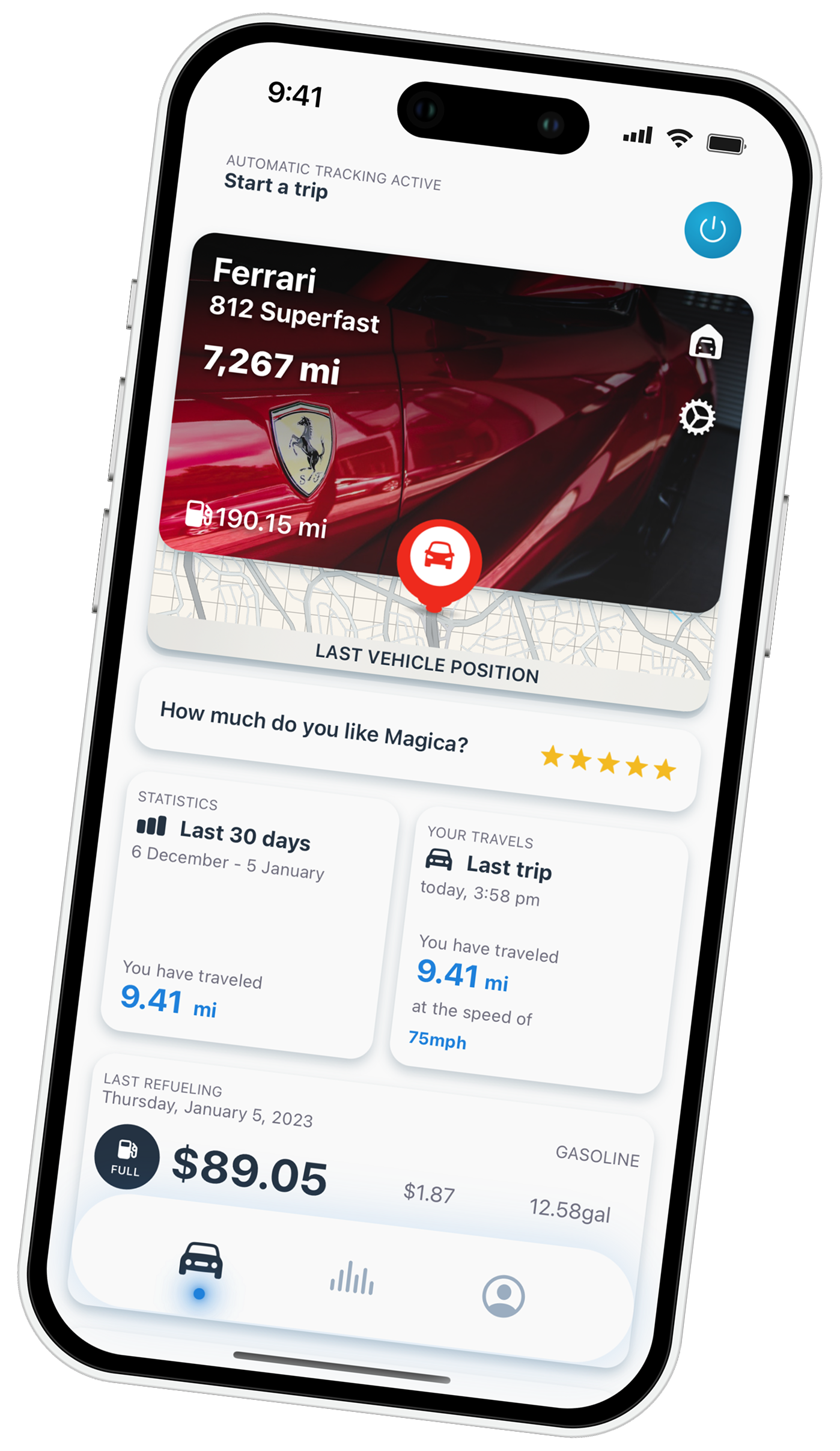
What no app can do for you
Three of the four things section 28-125(2) requires can be captured automatically. The fourth cannot, and neither can the timing rule.
Why the journey was made. No tracker knows this. It takes five seconds at the end of a job and it is the field a reviewer actually reads.
When the entry was made. “The record must be made at the end of the journey or as soon as possible afterwards.” An app that lets you classify three months of trips the night before you lodge has helped you build something that is not a contemporaneous record, however accurate the GPS was.
Whether the twelve weeks are representative. The ATO asks for a period “broadly representative of your travel” — the phrase is the ATO’s, not the Act’s, which is part of why it gets argued about. If you happen to pick your busiest quarter, the percentage flatters you and it is not defensible. Software cannot know that your March is not your November.
Frequently asked questions
What are the ATO logbook requirements?
A logbook must cover a continuous period of at least 12 weeks and be broadly representative of your travel. Each work-related journey needs an entry with the day the journey began and the day it ended, the odometer readings at the start and end of the journey, the kilometres travelled and why the journey was made, recorded at the end of the journey or as soon as possible afterwards. The logbook as a whole must also state when the period begins and ends, the odometer readings at the start and end of the period, the total kilometres travelled, the work-related kilometres and the resulting percentage. Every entry must be in English.
Do I have to record my private trips in an ATO logbook?
No. Section 28-125 asks for entries only for journeys made in the course of producing your assessable income. Your total kilometres for the period come from the odometer readings at the start and end, and the private figure is simply the difference. What the Act does warn is that leaving out a work trip lowers your business-use percentage, so the omissions that cost you money are the work ones.
How many kilometres can I claim without a logbook?
Up to 5,000 business kilometres per car per year, using the cents per kilometre method. For 2026–27 the rate is 91 cents per kilometre, so the maximum that method can produce is $4,550. You still need a record showing how you worked out the kilometres, and you cannot claim decline in value on top. Above 5,000 kilometres the Act requires you to discard the excess, which is usually the point at which twelve weeks of logbook is worth the effort.
Can my 12-week logbook period cross the end of the financial year?
Yes. Section 28-120(2) says the period “may overlap the start or end of the income year, so long as it includes part of the year”. A period that starts in late August finishes in November and sits inside 2026–27; a period that starts in May and finishes in August straddles two income years and is valid for both. This is why arriving late in a year does not lock you out of the logbook method.
Do I need a new logbook if I buy a new car?
It depends on whether the new car replaces the old one or joins it. If it replaces it, section 28-130 lets you nominate the new car as the replacement and carry the existing logbook across without repeating the twelve weeks — but the nomination has to be recorded in writing before you lodge that year’s return, stating that you are replacing the original car and the date it takes effect. If it is an additional car you want to use the logbook method for, section 28-115(4) requires a new logbook for that income year.
How long do I have to keep my ATO logbook?
Until the end of the latest income year in which you rely on it, and then another five years. Section 28-150 starts those five years on the due day for lodging your return for that latest year — 31 October if you lodge your own, later through a registered tax agent. A logbook kept in 2026–27 and relied on through 2030–31 therefore has to survive until 31 October 2036. If you do not keep it, the Act says you cannot deduct amounts worked out from its percentage, and an assessment already made can be amended to take them back.
Is my ute covered by the logbook rules?
Only if it is a ‘car’ as the Act defines it: designed to carry a load of less than one tonne and fewer than 9 passengers. The ATO says many four-wheel drives and some utes qualify, while utes or panel vans designed to carry one tonne or more are an ‘other vehicle’ and fall outside the two methods entirely — you claim the business portion of actual costs instead. Separately, section 28-170 exempts a panel van or utility truck from having to use either method where private use during the year was minor, infrequent and irregular. Both are worth checking with your tax agent before you commit to twelve weeks.
Can several work trips on the same day be one logbook entry?
Yes. Section 28-125(3): “If 2 or more journeys in a row are made in the car on the same day in the course of producing your assessable income, they can be recorded as a single journey.” One odometer reading at the start of the run, one at the end, one purpose line. It is the largest saving in the method, and only two of the seventeen ranking pages I read mention it. The caution is that merging hides detail, so keep a run of jobs together and split anything you might have to explain separately.
—
The rules here are general and current as at 28 August 2026, quoted from the Income Tax Assessment Act 1997 and ato.gov.au. Tax rules change and your circumstances are your own — talk to your registered tax agent before you lodge.
If you try Magica and something is missing for the way you work in Australia, email support. A lot of what is in the app got there because someone wrote in.
Try Magica for Free
Download the app and start automatically tracking your business trips. No credit card required.
Download Now




3 commenti su “ATO Logbook Requirements in 2026–27: What Division 28 Actually Says, and the Seven Rules Almost Nobody Quotes”
I commenti sono chiusi.