Work Related Car Expenses in 2026–27: Which Trips Count, Which Costs Count, and the 1958 Case That Still Decides Your Commute

On 3 September 2026 I pulled the Google Australia results for work related car expenses, work related travel expenses, travel expenses ato, car expenses ato and claiming fuel on tax, took the thirty-eight ranking pages that are not published by the ATO itself, and counted what they say. Twenty-four of the thirty-eight explain that you cannot claim the drive between home and work.
Not one of the thirty-eight names the case that decided it. It was decided in 1958, it is still the leading authority, and the sentence that does the work is short enough to quote.
That gap is the shape of the whole topic. The question people search for is which expenses they can claim. The answer almost always turns on which trips they took — and the trip rules live in a 2021 Commissioner’s ruling and a High Court judgment, not in the list of costs. So this piece goes in that order: the trips first, the costs second, and the things that look like car expenses but legally are not.
I build Magica, a logbook and mileage tracker, so I have a side in this. That is also why every rule below is quoted from the Income Tax Assessment Act 1997, from Taxation Ruling TR 2021/1 or from an ATO page, with a link on each one so you can check it yourself.
The constraint is the trip, not the expense
Everything starts at section 8-1, which lets you deduct a loss or outgoing incurred in gaining or producing your assessable income — and then takes it back for anything that “is a loss or outgoing of a private or domestic nature“.
That single phrase is why the drive to work fails. It is not that petrol is the wrong kind of expense; petrol burned on a work trip is deductible. It is that the trip itself is private, so the fuel it burns is private with it. Which trips are private, then, is the only question worth answering first.
For employees, the Commissioner answered it in TR 2021/1, issued 17 February 2021. One page out of thirty-eight cites it by name.
The case from 1958 that still decides your commute
TR 2021/1 calls Lunney “the leading judicial decision on the matter” and quotes it at paragraph 14. The operative sentence:
at the most, it may be said to be a necessary consequence of living in one place and working in another.
That is the test. Your commute is not caused by your job; it is caused by the distance between two addresses you chose. Zero of the thirty-eight pages carry that quote, or any case law at all.
It matters because it explains every strange result further down. Once the rule is “the expense must be caused by the work, not by where you live”, the ten situations below stop looking arbitrary.
The trips that stay private, even when they feel like work
The ATO’s Trips you can and can’t claim page, last updated 4 May 2026, lists the ones people argue about. You still cannot claim the trip between home and your regular place of work even if you:
- “live a long way from your regular place of work”
- work outside normal business hours — shift work, overtime
- do minor work-related tasks on the way, “for example, picking up the mail“
- go between home and work more than once in a day
- are on call
- “have no public transport near where you work or live“
- do some of your work at home
- run your own business from home and drive straight to a job where you work for somebody else
TR 2021/1 adds two more that no ranking page mentions. Paragraph 22: doing work while you travel does not convert the travel, and the example the Commissioner picked is “answering emails on the train“. Paragraph 18: “the mere fact that an employer asks the employee to attend their regular place of work on a particular day does not change the conclusion”. If your team has two mandatory office days a week, those two drives are still private.
And paragraph 23 covers the version nobody thinks about: if you drive to the office from somewhere you were doing something private — “a café or a holiday location” — that trip is not deductible either.
The trips you can claim, and the one that quietly stops being claimable
The deductible list is shorter and more useful. You can claim transport on trips taken in the course of performing your duties: from your regular workplace to a client, between two workplaces of the same employer, between two separate jobs where neither end is your home, from home to an alternative place of work such as a training venue.
Nine of the thirty-eight pages use the phrase “alternative workplace”. None of them mention what happens when the alternative one stops being alternative.
The ATO’s own example is Brock, who normally works at his employer’s city office in Melbourne and occasionally attends training at the Box Hill office. Those occasional trips are deductible. But:
if Brock works from the city office every Monday to Thursday and from the Box Hill office every Friday as a standard arrangement
then Box Hill is a regular place of work on Fridays, and the Friday drive is not deductible any more. Nothing about the drive changed. The pattern changed.
This is the single most common way a genuine claim goes bad, and it is worth marking in your records the moment a site becomes routine — because the deduction ends on the day the arrangement becomes standard, not on the day you notice.
The three exceptions, and the details that get left out
There are three ways a home-to-work trip becomes deductible. Nineteen of the thirty-eight pages list them. The details below are the parts that get dropped.
Home as a base of employment. Three conditions, all of them: you start your duties at home, working in two locations is necessary because of the nature of the duties, and the trip is not part of a normal journey to work that would have happened anyway. TR 2021/1 draws the line with two nurses’ worth of daylight between them: an on-call consultant who starts fixing the fault at home and drives in to finish it can claim; someone waiting at home on standby who commences duty on arrival cannot.
Bulky tools and equipment. The tools must be essential, genuinely awkward to move by anything but a vehicle, and there must be no secure storage at the workplace. Two things get lost here. First, if you claim, the ATO wants a record of “the size and weight of all work items” and “evidence that your employer did not provide secure storage at the workplace” — zero of the thirty-eight pages mention that second one, and it is the one your employer has to help you prove. Second, TR 2021/1 paragraph 80 offers a route the ATO’s web page does not: the storage test is satisfied where there is no secure area or where “the equipment needs to be transported to a different site each day“. Zero of thirty-eight have it.
The ATO’s counter-example is worth keeping in mind: Merinda is a fitter and turner on a mine site with a large, heavy toolkit and a secure locker at work. She takes it home anyway. “There’s no practical need … so her trips remain ordinary private trips.”
Itinerant work. A web of workplaces, no fixed base, several sites before you go home. The trap is Chloe, a substitute teacher who drives to a different school each day: “While she may not know where she’s going to work each day, she will only ever work at one location for the day.” Unpredictable is not the same as itinerant. Multiple sites in the same day is the test.
If you work from home, one sentence in the ruling changes everything
Paragraph 78 of TR 2021/1 is the most valuable sentence in the document for anyone hired remotely, and no page in the set quotes it:
Where an employee has an area of their home set aside as their sole base of operations because their employer provides them with no other location to work from, that area of their home becomes their regular place of work.
Read what that does. If the employer has no office for you at all, home is not a convenience — it is your regular place of work. And trips from a regular place of work to perform your duties are deductible, so the drive to a client’s premises starts at your front door.
The mirror image is paragraph 45: where the duties are such that “it does not matter where they are carried out“, travelling to wherever you choose to work is mere convenience and not deductible. Paragraph 77 puts it bluntly — a person working remotely “cannot deduct the cost of travel to a resort” they choose to work from. The difference is not where you sit. It is whether the employer gave you an alternative.
What is a car expense, and the four things that are not
Now the costs. Section 28-13 defines a car expense broadly: “a loss or outgoing to do with a car”, plus operating costs, plus the decline in value. In practice that is fuel and oil, repairs, servicing, cleaning, registration, insurance, interest on a car loan, lease payments and depreciation.
The ATO’s list of what is not a car expense has four items:
- the purchase price of the car
- the principal repayments on a car loan — the interest is a car expense, the principal never is
- modifications, alterations or improvements
- parking and tolls
The first two are capital and everyone expects them; three pages out of thirty-eight say so. Modifications are not lost, though: they go onto the cost of the car “as a second element cost” and come back slowly through the decline in value.
The fourth item is the one that surprises people, and it deserves its own section.
Parking and tolls are deductible. They are just not car expenses.
Nineteen of the thirty-eight pages mention parking or tolls. Three of them put them in the right box.
Parking fees and road tolls incurred on a work-related trip are deductible. But because they are not car expenses, they do not go through either of the two car methods. The ATO’s myTax 2026 instructions list them under work-related travel expenses: “taxi, ride-share and public transport fares, airfares, short-term car hire, road and bridge tolls and parking fees“.
Two practical consequences follow, and both are money.
If you use the cents per kilometre method, the 91-cent rate for 2026–27 covers your running costs — it does not cover the toll you paid getting to the client. That is claimed separately, on top. And if you use the logbook method, tolls and parking on a work trip are not multiplied by your business use percentage: the trip was work, so the toll was work, and the whole amount is claimed as a travel expense.
One caveat on that 91-cent figure: it belongs to kilometres driven from 1 July 2026. The return being lodged this spring is for 2025–26, at 88 cents — which year’s ATO km rate you use, and why the new one is 89 plus 2.
Which parking, though, matters. The ATO is explicit: “You can’t claim a deduction for parking at or near a regular place of work.” The station car park on your commute is private. The two hours in front of the client’s building is not.
If you are still deciding between the two methods themselves, that comparison is a separate piece of arithmetic — I worked it through in logbook method vs cents per km, where the crossover turns out to be a cost per kilometre rather than a distance.
The two things the Act carves out by name
Here is the piece of drafting I like most, and zero of the thirty-eight pages contain either half of it.
Section 28-13(3) says none of the following is a car expense: “a loss or outgoing incurred, or a payment made, in respect of travel outside Australia“, and “a taxi fare or similar loss or outgoing”.
Then section 900-30(6), under the heading Motor vehicle expenses excluded, says a loss or outgoing to do with a motor vehicle is not treated as a work expense — unless it is travel outside Australia, or a taxi fare.
The same two items, in the same order, excluded from one regime and admitted to the other. The Act splits the world in half and leaves no overlap. Which is why a taxi to a client is a straightforward work-related travel expense with a receipt, while the identical trip in your own car has to go through a logbook or a cents-per-kilometre calculation, and why hiring a car overseas for work never touches section 28-12 at all.
Fines, licences, and the accident you cause while working
Three more from the ATO’s parking, tolls, accidents, licence and fines page, updated 8 June 2026.
Fines are never deductible, including the ones you collect while working. The ATO’s example is Warren, who parks in a loading zone because he is running late between the office and a building site: “It doesn’t matter that he is working at the time he is issued with the fine.”
Your licence is private; a work permit is not. Rhonda works on a sugar cane farm and needs both a driver’s licence and a heavy vehicle permit. The $45 licence renewal is not deductible even though the job requires it. The $73 permit is. The line is whether the cost is additional and specific to the work.
If you damage someone else’s vehicle while driving for work, that is deductible — the repairs to your own car, and “damages or compensation for the damage to the other vehicle if you are liable”. Zero of thirty-eight pages mention it, and it is the largest single number on this list for the unlucky person who needs it.
If your vehicle is not a car, none of the above applies
A car, for tax, is a motor vehicle that “carries a load of less than one tonne and fewer than 9 passengers (including the driver)”. Anything else — a motorbike, a one-tonne ute, a nine-seat van — is not a car, and section 28-12 does not reach it.
The ATO is direct about the consequence: for those vehicles “you can’t use the cents per kilometre method or the logbook method“. You work out actual expenses, apply a work-use percentage, and claim the result as a work-related travel expense. Two pages out of thirty-eight say this.
The worked example on the ATO page is Ben’s motorbike. Over twelve weeks he records 800 kilometres, of which 600 are for work, giving 75%. His costs for the year are fuel and oil $560, repairs $400, registration $540, compulsory third party $300 and decline in value $1,800 — $3,600 in total. His deduction is $3,600 × 75% = $2,700.
Note what he still did: he kept a logbook-shaped record even though no logbook was legally required, because there is no other honest way to produce the 75%. The ATO says as much — it is “not a requirement”, but “it is the easiest way to show how you calculated” the work-related share.
Who owns the car matters more than whose name is on the rego
To claim car expenses you must own, lease or hire the car. Two situations bend that, and three of the thirty-eight pages get to them.
The first is the family car. The ATO’s example is Rory, who bought her parents’ car for $1,000, pays the insurance, fuel and registration, and is the only person who drives it — but the registration is still in her mother’s name. She can claim, “even though the registration hasn’t been changed to her name”, because she can show a private arrangement that made her the owner. Substance beats the rego papers.
The second runs the other way. A car under a salary sacrifice or novated lease is usually leased by your employer, so you do not own it and cannot claim running costs at all. You can still claim “additional expenses, like parking and tolls” for your work use of it — which, given the previous section, is exactly the kind of expense that was never a car expense in the first place.
If you drive an EV or a plug-in hybrid and you use the home charging rate in PCG 2024/2, the ATO wants “an electricity bill for your residential premises” to show you incurred the cost. And a detail with a date on it: “PCG 2024/2 is only available for PHEVs from 1 July 2024 onwards.”
The $300 rule does not do what you think it does
Almost everyone in Australia knows the rule of thumb: under $300 of work expenses and you do not need written evidence. It is real, and it is in TR 2020/1 at paragraph 56 — with a parenthesis that changes everything:
If the total of work expenses is $300 or less (not including certain car, travel allowance expenses and meal allowance expenses)…
Car expenses sit outside that threshold, and the ruling’s own footnote sends you to section 28-35 and subsection 900-70(3) for the rules that apply instead. Zero of thirty-eight pages carry the exclusion.
That is the position for the 2025–26 return being lodged now. From the 2026–27 income year the threshold itself is gone: Schedule 4 of the Treasury Laws Amendment (Tax Reform No. 1) Act 2026, which received royal assent on 26 June 2026, repeals sections 900-35 to 900-45 and puts a $1,000 standard deduction in their place — one that is reduced dollar for dollar by your car expense claim. How that plays out for a person paid a car allowance is in car allowance in Australia.
In practice that means two things. Claiming $280 of car expenses does not exempt you from the substantiation rules of Division 28 — you still need a valid method. And the reason the cents per kilometre method needs no receipts is not the $300 rule; it is section 28-35, a separate exemption that belongs to that method alone. If you want the full set of records the other method demands, that is in ATO logbook requirements.
What to actually record
Strip the above down to a list and there are four things worth capturing as you go, because none of them can be reconstructed in July.
- The purpose of each trip, in enough words to survive a question. “Client — Ipswich” beats “work”.
- Both ends of the trip, because the deduction lives in the pair, not in the distance. Home to client is one thing; home to office is another.
- When a site becomes routine. The Brock rule turns a deductible trip into a private one without warning.
- Tolls, parking and taxi fares separately from the car itself, because they are claimed in a different place on the return.
Where Magica fits, and where it does not
Magica is the app I build, and it does exactly one part of this: it records the trips. It logs them automatically by Bluetooth or motion, classifies them as work or private, holds the purpose and both endpoints, and exports an ATO-shaped logbook you can hand to your accountant. Everything stays on the device — the data is not on a server of mine, because there is no server of mine to put it on. That is an architecture decision, not a marketing promise. If you are comparing it against the ATO’s own free tool and the other apps in the category, I went through that in ATO logbook app.

Try Magica for Free
Download the app and start automatically tracking your business trips. No credit card required.
Download Now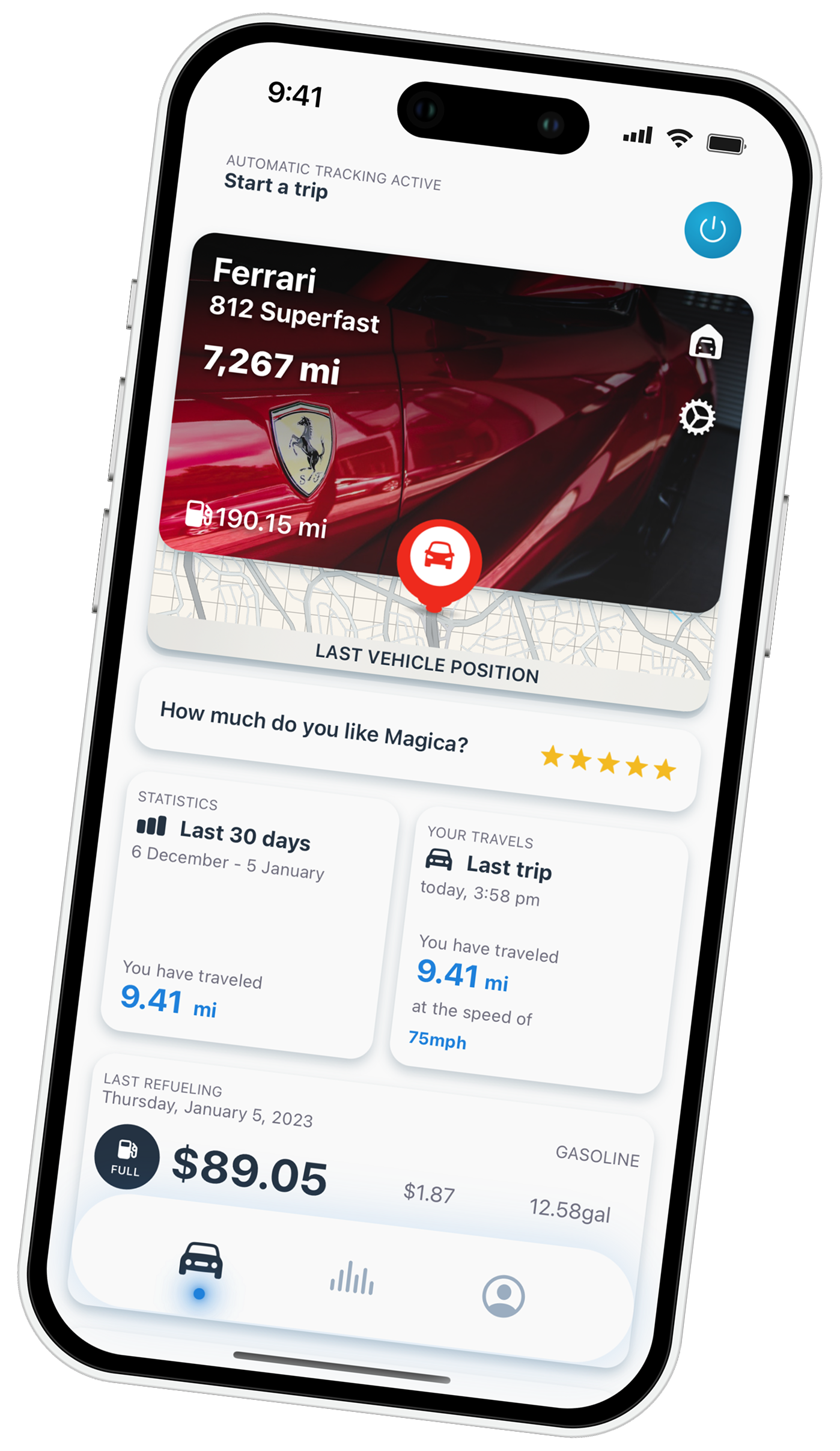
What it will not do is decide whether a trip is deductible. That call needs facts the phone cannot see: whether your employer provides you an office, whether the toolkit has a locker at the depot, whether Friday at the second site has become a standard arrangement. The app can hold the answer once you have made it. It cannot make it.
What no app can tell you
Three questions decide most claims, and all three are about your employment rather than your driving.
Does your employer give you a place to work? If the answer is genuinely no, paragraph 78 puts your regular place of work at home and changes the status of every trip out of it.
Is the second site occasional, or is it now the arrangement? The Brock example is the difference between a deduction and an audit finding.
Who paid? Everything above assumes you spent the money and were not reimbursed. If your employer reimburses the expense, there is nothing to claim; if they pay you an allowance instead, the allowance is assessable income and the expense is claimed separately.
The rules quoted here are the ones the ATO and the Act publish, and they are general. Your circumstances are not, so check them with your tax agent before you lodge — particularly if you are in one of the three exceptions, where the facts do all the work.
Try Magica for Free
Download the app and start automatically tracking your business trips. No credit card required.
Download Now
Frequently asked questions
What work-related car expenses can I claim in 2026–27?
Fuel and oil, repairs, servicing, cleaning, registration, insurance, interest on a car loan, lease payments and the decline in value of the car — but only for work-related trips, and only through the cents per kilometre method or the logbook method. The purchase price, the principal on a car loan, modifications, and parking and tolls are not car expenses.
Can I claim the drive between home and work?
Generally no. The High Court settled it in Lunney in 1958: the cost is “a necessary consequence of living in one place and working in another”, so it is private. There are three exceptions — your home is a base of employment, you carry bulky tools with no secure storage at work, or you do itinerant work with several sites in the same day.
Can I claim parking and tolls on my tax return?
Yes, if you incur them on a work-related trip — but not as car expenses. The ATO lists road and bridge tolls and parking fees under work-related travel expenses, so they are claimed separately from the cents per kilometre or logbook calculation. Parking at or near your regular place of work is private and cannot be claimed.
Can I claim fuel if I use the cents per kilometre method?
No. The 91 cents per kilometre rate for 2026–27 already covers fuel, oil, servicing, registration, insurance and depreciation, so claiming petrol on top would be claiming it twice. Fuel is claimed as an actual cost only under the logbook method.
I work from home. Can I claim the trip to a client?
If your employer provides no other location for you to work from, yes. Paragraph 78 of TR 2021/1 says that in that case the area of your home set aside for work becomes your regular place of work, and trips from it to perform your duties are deductible. If you work from home for convenience while an office is available, the trips are private.
Are parking fines deductible if I get them while working?
No. Fines and penalties are never deductible, including parking and speeding fines incurred during work. The ATO’s own example is a worker who parks in a loading zone between jobs: it does not matter that he was working when the fine was issued.
Can I claim car expenses for my ute or motorbike?
Not as car expenses. A ute with a carrying capacity of one tonne or more, a motorbike, and a vehicle carrying nine or more passengers are not cars for tax purposes, so neither the cents per kilometre method nor the logbook method is available. You claim actual expenses multiplied by a work-use percentage, as a work-related travel expense.
Does the $300 no-receipts rule cover car expenses?
No. TR 2020/1 states the threshold applies to work expenses “not including certain car, travel allowance expenses and meal allowance expenses”. Car expenses have their own substantiation rules in Division 28, which is why the cents per kilometre method needs no written evidence — that comes from section 28-35, not from the $300 rule.




2 commenti su “Work Related Car Expenses in 2026–27: Which Trips Count, Which Costs Count, and the 1958 Case That Still Decides Your Commute”
I commenti sono chiusi.