Car Maintenance Schedule: What Your Car Actually Requires, and Who Decides
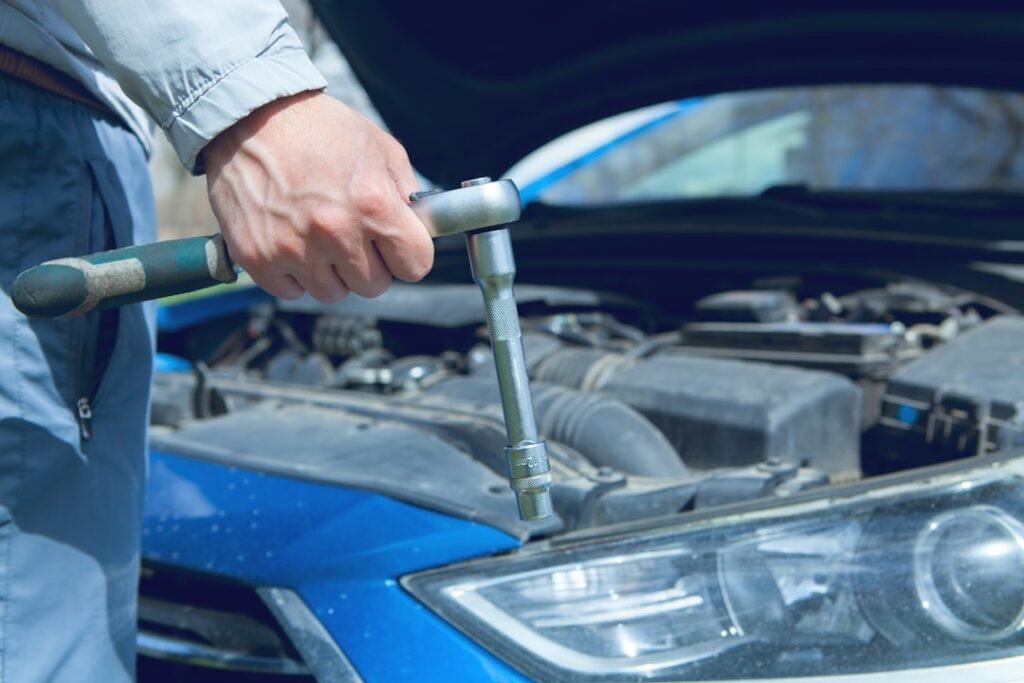
Two manufacturers selling cars in the same American showrooms do not agree on what a car maintenance schedule even is. Open the 2026 Mazda CX-5 booklet and you get a grid of miles: oil at 10,000, spark plugs at 70,000, coolant at 120,000. Open a Honda Pilot manual and there is no mileage figure for the oil change at all — the car works it out and shows you a percentage.
Both are correct. Both are the manufacturer’s official schedule. And neither one looks like the 30/60/90k checklist that fills the first page of search results, because that checklist is an average of cars that do not exist. Of the thirty-five organic results I pulled in August 2026 for the two commonest versions of this question, eighteen belonged to dealerships, repair chains, tire shops or parts sellers — the businesses that get paid when the checklist is followed.
So this is not another generic list. It is what the manufacturers actually publish, what the second schedule (the one most drivers qualify for) changes, what federal law says about who is allowed to touch the car, and what all of it costs now that shop prices have risen at almost twice the rate of everything else.
The same question, two completely different answers
Mazda still does it the classic way. The 2026 CX-5 booklet for the United States, Canada and Puerto Rico sets a ceiling and fills a table under it:
Maximum interval 16,000 km (10,000 miles) or 12 months, whichever comes first.
| Item | 2026 Mazda CX-5, normal schedule |
|---|---|
| Engine oil and oil filter | Every 10,000 miles or 12 months (maximum interval) |
| Spark plugs | Replace every 112,000 km (70,000 miles) |
| Coolant | First at 192,000 km (120,000 miles) or 10 years, then every 96,000 km (60,000 miles) or 5 years |
| Tire rotation | Rotate every 16,000 km (10,000 miles) |
| Cabin air filter | Replace every 48,000 km (30,000 miles) or 2 years |
| Coolant level, tire pressure and wear, all lights | Inspect at every service |
Honda’s Pilot manual has none of that for the oil. What it has is the Maintenance Minder, a system that computes remaining oil life from how the engine has actually been running and prints it as a percentage. At 15% the dash says Maintenance Due Soon. At 5% it says Maintenance Due Now. Past zero it starts counting negative miles, and the display blinks.
The work itself is coded rather than dated. A letter tells you what has to happen to the oil, a number tells you what else is due at the same visit:
| Code | Honda Maintenance Minder item |
|---|---|
| A | Replace engine oil |
| B | Replace engine oil and oil filter, inspect front and rear brakes, tie rod ends, steering gearbox and boots, suspension components, driveshaft boots, brake hoses and lines, all fluid levels, exhaust system, fuel lines and connections |
| 1 | Rotate tires |
| 2 | Replace air cleaner element and dust and pollen filter, inspect drive belt |
| 3 | Replace transmission fluid (and transfer fluid) |
| 4 | Replace spark plugs, replace timing belt and inspect water pump |
| 5 | Replace engine coolant |
| 6 | Replace rear differential fluid |
| 7 | Replace brake fluid |
The only mileage-free guarantee Honda gives is a calendar backstop, printed as a footnote: “If the message Maintenance Due Now does not appear more than 12 months after the display is reset, change the engine oil every year.” Brake fluid gets the same treatment at three years.
That difference matters more than it looks. A Mazda owner who drives 6,000 gentle highway miles a year still changes the oil once a year, because the ceiling is time as well as distance. A Honda owner doing the same thing might see the percentage barely move — and the manual then sends them to the annual backstop anyway. Same outcome, arrived at from opposite directions, and neither route is “every 5,000 miles.”
The second schedule, and why you are probably on it
Almost every manufacturer publishes two schedules. The one everybody quotes is the normal one. The other is for what the industry calls severe service, and reading the conditions is a slightly uncomfortable experience, because they describe ordinary life.
Mazda lists seven, verbatim:
- the vehicle is idled for long periods or driven at low speeds, such as with police cars, taxis, or driver’s education school car;
- the vehicle is driven mainly on unpaved road or in dusty area;
- the vehicle is driven mainly on mountain roads or uphill roads;
- regularly driving too short distances for engine warm-up to be completed;
- driving under extremely high temperature conditions;
- driving for long periods in cold temperatures, extremely wet or heavy rain conditions;
- if the brakes are used extensively (for example, continuous hard driving or mountain driving) or if the vehicle is operated in extremely humid climates.
Here is the part that most checklists get wrong. Those seven conditions do not all trigger the same items. Mazda maps each condition to the specific parts it affects, and the oil interval halves for only three of them — idling and low speeds, unpaved or dusty roads, mountain and uphill driving:
Replace at every 8,000 km (5,000 miles) or 6 months (at half the above Maximum interval).
Short trips, the condition most drivers assume is the worst thing they do to an engine, appear in Mazda’s table against the drive belts, not the oil. Extensive braking or a humid climate triggers brake fluid, which on the severe schedule becomes Replace annually. Dust triggers the air filter. It is a matrix, not a switch, and the difference between reading it and skimming it is a few hundred dollars a year.
Honda does the same thing from the other side. Because the car measures the engine’s actual working conditions, most of severe service is already inside the percentage. What Honda still spells out as footnotes are the things the sensors cannot see:
| Honda exception | Interval |
|---|---|
| Driving in dusty conditions | Replace air cleaner element every 15,000 miles |
| Urban areas with high concentrations of soot from industry and diesel vehicles | Replace dust and pollen filter every 15,000 miles |
| Driving regularly over 110 °F, under −20 °F, or towing a trailer | Replace timing belt every 60,000 miles |
| Mountainous areas at very low speeds, or trailer towing | Rear differential fluid at 7,500 miles, then every 15,000 miles |
Two brands, two philosophies, one shared conclusion: the interval that applies to you is a function of where and how you drive, and no generic table on the internet knows either of those things.
What choosing the wrong column costs
Take the CX-5 at 12,000 miles a year. On the normal schedule the 10,000-mile ceiling arrives first, so five years of ownership is six oil services. On the severe schedule, at 5,000 miles or six months, the same five years is twelve — six extra visits, with brake fluid moving to annually on top.
Guessing high is expensive. Guessing low can be worse, and this is where the second half of the story starts, because the moment something breaks, somebody is going to ask which column you were on and what you did about it.
Who is allowed to touch the car — this part is federal law
The single most common belief about maintenance in the United States is also flatly wrong: that skipping the dealer voids the warranty.
The Magnuson-Moss Warranty Act, 15 U.S.C. §2302(c), says the opposite:
No warrantor of a consumer product may condition his written or implied warranty of such product on the consumer’s using, in connection with such product, any article or service (other than article or service provided without charge under the terms of the warranty) which is identified by brand, trade, or corporate name.
The FTC’s own regulation, 16 CFR §700.10(c), removes any remaining ambiguity and even supplies the forbidden sentence as an example:
No warrantor may condition the continued validity of a warranty on the use of only authorized repair service and/or authorized replacement parts for non-warranty service and maintenance. […] For example, provisions such as, “This warranty is void if service is performed by anyone other than an authorized ‘ABC’ dealer and all replacement parts must be genuine ‘ABC’ parts,” and the like, are prohibited where the service or parts are not covered by the warranty.
And the FTC’s consumer page says it in plain English:
You don’t have to use the dealer for repairs or maintenance to keep your warranty in effect. In fact, it’s illegal for a dealer to deny your warranty coverage because you had routine maintenance or repairs done by someone else.
Aftermarket and recycled parts are covered by the same rule. If a manufacturer wants to deny a claim because of one, the FTC says the burden runs the other way: “The manufacturer or dealer must prove the aftermarket or recycled part caused the damage before they can deny warranty coverage.”
The manufacturers know this perfectly well, and it shows in their own documents. Mazda’s schedule carries a footnote stating that, according to state, provincial and federal regulations, failure to perform maintenance on the emission-related items listed “will not void your emissions warranties.” Honda’s manual goes further and plans for it: after a service, “the dealer will reset the Maintenance Minder display… If someone other than a dealer performs maintenance service, reset the Maintenance Minder display yourself.”
That last sentence is worth a second read. Honda is not merely tolerating an independent shop. It is telling you that when you use one, resetting the interval clock becomes your job — and that failing to do it “results in the system showing incorrect maintenance intervals, which can lead to serious mechanical problems.”
There are two real limits to all this, and they are narrow. If the work is done free under the warranty, the manufacturer can pick the shop. If a part is supplied free under the warranty, it can pick the part. Everything you pay for yourself is yours to place.
The catch nobody mentions: the burden of proof is yours
Here is the other half of the rule, and it is the half the FTC page and the manufacturers agree on word for word.
Hyundai’s 2026 Owner’s Handbook & Warranty:
It is your responsibility to make sure that all of the scheduled maintenance is performed and that the materials used meet Hyundai engineering specifications. Failure to perform scheduled maintenance as specified in the Hyundai Owner’s Manual will invalidate warranty coverage on parts affected by the lack of maintenance. Make sure that receipts for completed maintenance work are retained with the vehicle.
And, in the list of what the owner is responsible for:
Retain maintenance service records. It may be necessary for you to show that the required maintenance has been performed.
The FTC says the same thing about the extended warranties and service contracts sold on top: “The contract might require you to follow all the manufacturer’s recommendations for routine maintenance, like oil changes. If you don’t, it might void the contract and end coverage. Keep your service records and receipts to show you’ve maintained your vehicle.”
Put the two halves together and the actual American rule on car maintenance is not complicated:
You can have the work done anywhere you like. You just have to be able to prove it was done.
That is a records problem, not a mechanical one. A dealer that services the car keeps that history for you, which is a large part of why dealer service feels safer than it needs to be. Do it anywhere else — an independent shop, a chain, your own driveway — and the history exists only if you keep it: date, odometer reading, what was done, and the receipt.
Keeping it is the entire reason Magica has a maintenance log with receipt scanning and scheduled reminders attached to each vehicle. Everything stays on the phone, nothing goes to a server of mine, and the record is exportable the day a warranty claim, a service contract, or a buyer asks for it.

Try Magica for Free
Download the app and start automatically tracking your business trips. No credit card required.
Download Now
What the schedule costs now, and why it keeps climbing
Two numbers frame the money.
The first is what maintenance costs per mile. AAA’s Your Driving Costs study for 2025, built on five years and 75,000 miles of ownership, puts maintenance, repair and tires at a weighted average of 11.04¢ per mile — against 13.00¢ for fuel. Over the study period that is $8,280, and it lands within a couple of cents of that average almost everywhere:
| Vehicle category (AAA 2025) | Maintenance, repair and tires | Fuel |
|---|---|---|
| Small sedan | 10.23¢/mile | 9.90¢/mile |
| Medium sedan | 11.91¢/mile | 11.13¢/mile |
| Subcompact SUV | 10.79¢/mile | 12.12¢/mile |
| Compact SUV (FWD) | 11.64¢/mile | 11.43¢/mile |
| Medium SUV (4WD) | 11.79¢/mile | 14.65¢/mile |
| Midsize pickup | 11.44¢/mile | 16.79¢/mile |
| Half-ton crew-cab pickup | 11.36¢/mile | 17.84¢/mile |
| Hybrid | 9.75¢/mile | 8.55¢/mile |
| Electric | 10.07¢/mile | 5.07¢/mile |
| Weighted average | 11.04¢/mile | 13.00¢/mile |
Notice how flat that column is compared with the fuel column next to it. Fuel cost varies by a factor of three and a half across the categories; maintenance varies by about 20%. Choosing a cheaper car to run is mostly a fuel decision, not a maintenance one — which is a different way of saying that a fuel-efficient car buys you far more than a supposedly cheap-to-service one.
The second number is where the schedule has quietly become a bigger line in the budget. The Bureau of Labor Statistics publishes a consumer price index for motor vehicle maintenance and repair, and it has badly outrun the general index:
| July, index level | Motor vehicle maintenance and repair | All items |
|---|---|---|
| 2019 | 295.377 | 256.571 |
| 2022 | 343.678 | 296.276 |
| 2023 | 387.159 | 305.691 |
| 2024 | 405.109 | 314.540 |
| 2025 | 431.604 | 323.048 |
| 2026 | 460.185 | 333.918 |
From July 2019 to July 2026 the price of keeping a car serviced rose 55.8%, while everything an American household buys rose 30.1%. In the last twelve months alone it went up 6.6% against 3.4% for the general index. The schedule has not changed; the bill for following it has, at nearly double the pace of inflation.
That is the real argument for knowing which column of the schedule applies to you, rather than paying for the shorter one out of vague anxiety. If you want the shop-price side of the same question, I broke it down by brand in the piece on car service costs.
Three things on every checklist that do not do what you think
The Department of Energy and the EPA jointly run fueleconomy.gov, and its maintenance page is the rare source with no service to sell. It is also where three pieces of standard checklist advice fall apart.
The air filter does not save you fuel. In the site’s words: “Replacing a clogged air filter on vehicles with fuel-injected, computer-controlled gasoline engines — such as those manufactured from the early 1980s to the present — or diesel engines does not improve fuel economy, but it can improve acceleration.” The improvement is real on a carbureted engine — the page dates fuel injection to the early 1980s, so that is a car older than most drivers on the road. Every article that lists a fresh air filter under “ways to improve your gas mileage” is repeating advice that stopped being true when your car got fuel injection. Replace it for the airflow and the engine’s sake; do not expect it back at the pump.
Tire pressure does save you fuel, but not much — and the number on the tire is the wrong number. The warning light is no help either: FMVSS No. 138 lets it stay dark until a tire is 25 percent below the placard pressure, which on a 35 psi car is 26.25 psi, and every psi in that gap is wearing the shoulders — the standard, and the tread arithmetic that follows from it, are in how long do tires last. Proper inflation improves mileage by 0.6% on average, up to 3% in the worst cases, and under-inflated tires cost about 0.2% for every 1 psi below spec. The correct pressure, per the same page, “is usually found on a sticker in the driver’s side door jamb or the glove box and in your owner’s manual. Do not use the maximum pressure printed on the tire’s sidewall.” That sidewall figure is the tire’s limit, not the car’s recommendation, and inflating to it is a common and quietly wrong habit.
The grade of oil is worth more than the brand of oil. Using the manufacturer’s recommended grade improves gas mileage by 1% to 2%. Putting 10W-30 into an engine designed for 5W-30 costs that same 1% to 2%. Nothing on the page suggests the label on the bottle matters beyond meeting the specification the manual asks for.
None of the three is a reason to skip maintenance. They are a reason to be suspicious of any list that presents routine work as a money-saving investment. Most of it is not an investment; it is the cost of the car continuing to be a car. If you want to know what your own fuel side is really doing, measuring it yourself beats any of these percentages.
Where the published schedule stops — and where the car keeps going
Look at the Mazda table again and count the columns. It runs to eight services. At 10,000 miles each, the published grid ends at 80,000 miles. A handful of long-life items reach further — coolant is the one that goes to 120,000 miles or ten years — but the schedule as a schedule stops well short of the car’s life.
Now look at how long American cars actually last. S&P Global Mobility, in its May 2025 analysis, put the average age of light vehicles in operation at 12.8 years — a two-month increase for the second consecutive year. Passenger cars alone averaged 14.5 years; light trucks 11.9. There were 289 million vehicles on the road and passenger cars fell below 100 million for the first time since the 1970s.
Twelve to fifteen years, at any normal mileage, is well past where the booklet’s grid ends. For the entire second half of a typical American car’s life there is no manufacturer schedule at all — only what the last entries imply, what the car’s own monitors report, and whatever history the owner has kept.
One thing does keep running in that stretch, and hardly anyone knows it. Federal law requires an emissions warranty independent of the bumper-to-bumper coverage. Hyundai’s 2026 handbook lists it as 5 years / 60,000 miles for federal emissions coverage and 8 years / 80,000 miles for specific major components. Mazda’s booklet adds that missing scheduled maintenance on those emission items “will not void your emissions warranties.” If a catalytic converter or an engine control module fails at 70,000 miles, that is worth checking before paying for it.
For what it is worth, the brand you bought moves this needle less than reputation suggests — I went through the four big reliability studies for the most reliable car brands and they picked four different winners.
How I would actually run a maintenance schedule
Stripped of everything above, the practical version is short.
- Get the real schedule, once. It is in the owner’s manual or the warranty and maintenance booklet, and both are usually free downloads on the manufacturer’s owner site. Ten minutes, and it replaces every generic checklist permanently.
- Decide normal or severe honestly, item by item. Not as one global switch. Dusty road commute? That is the air filter and the oil. Mountain roads and hard braking? Brake fluid. Mostly highway at steady speed? You are probably on the normal column and paying for the severe one.
- Log every service the day it happens. Date, odometer, what was done, and a photo of the receipt. This is the part that satisfies both the manufacturer and, later, a buyer. What that buyer should be asking, and which of those questions federal law already answers in writing, is set out in questions to ask when buying a used car.
- Let the reminders come to you. Once the intervals are in, the next due date is arithmetic. There is no reason to hold it in your head, and holding it in your head is how services get missed by four months.
- Keep the cost visible. Maintenance runs around 11¢ a mile whether or not you are watching, and together with fuel it is one of the two operating costs AAA counts per mile, on top of the ownership costs that make up your real cost per mile.
Points 3, 4 and 5 are exactly what I built the maintenance side of Magica to do: services and receipts logged per vehicle, deadlines with advance notifications, and a cost report that tells you what the schedule is actually costing per mile. It is an iPhone and Android app, everything stays on the device, and there is a longer walkthrough of the maintenance side here.
Try Magica for Free
Download the app and start automatically tracking your business trips. No credit card required.
Download Now
Frequently asked questions
How often should I really change my oil?
Whatever your manufacturer publishes for your engine, on the column that matches your driving. Mazda’s 2026 ceiling is 10,000 miles or 12 months, halved to 5,000 miles or 6 months under three specific severe conditions. Honda publishes no mileage at all and computes remaining oil life, with a 12-month backstop if the message never appears. The generic 3,000-mile figure appears in neither of those two schedules.
Does going to an independent shop void my warranty?
No. It is prohibited by 15 U.S.C. §2302(c) and by 16 CFR §700.10(c), and the FTC states plainly that it is illegal for a dealer to deny warranty coverage because routine maintenance or repairs were done by someone else. The two exceptions are work and parts provided free under the warranty, which the manufacturer may direct.
Do aftermarket parts void the warranty?
No. Coverage stays in effect. If a manufacturer wants to deny a claim on the grounds that an aftermarket or recycled part caused the failure, the FTC’s position is that the manufacturer or dealer has to prove that link first.
What actually counts as severe service?
It is defined by the manufacturer, not by a general rule, and each condition maps to specific items. Mazda’s list includes long idling or low speeds, unpaved or dusty roads, mountain and uphill driving, short trips too brief for warm-up, extreme heat, long cold or very wet periods, and heavy braking or high humidity. Only the first three shorten Mazda’s oil interval.
How long do brakes last?
Neither of the two schedules above puts a replacement mileage on pads and discs, because wear depends almost entirely on how and where the car is driven — which is why brake inspection appears at every service on Mazda’s schedule and inside Honda’s B code. What manufacturers do schedule is the brake fluid: on the CX-5’s severe column, annually. There is no federal replacement interval for pads either — only a minimum thickness, in a rule that says it binds nobody: how long do brake pads last.
Is synthetic oil the reason intervals got longer?
Longer intervals come from a combination of oil chemistry, tighter engine tolerances and, on cars like Honda’s, monitoring that measures the oil’s actual working life instead of guessing. Whichever the cause, the number that governs you is the one in your manual, not the one on the bottle.
How long do cars last these days?
Long enough that the schedule runs out first. S&P Global Mobility put the average U.S. light vehicle at 12.8 years in its May 2025 analysis, with passenger cars averaging 14.5 years, while the Mazda grid above stops at 80,000 miles.
Do I have to keep receipts if I do the work myself?
If you want the warranty argument to be winnable, yes. Hyundai’s 2026 handbook asks owners to retain maintenance service records because “it may be necessary for you to show that the required maintenance has been performed,” and the FTC gives the same advice for service contracts. Parts receipts plus a dated log with the odometer reading is the version of that record you can actually produce years later.
—
This article explains what manufacturers and federal agencies publish about maintenance schedules and warranties. It is not mechanical or legal advice for a specific vehicle: the schedule that governs your car is the one in its own owner’s manual, and a specific warranty question belongs with the manufacturer or a qualified professional. Sources: 2026 Mazda CX-5 and CX-90 scheduled maintenance, Honda Pilot owner’s manuals for the 2022 and 2025 model years (Maintenance Minder), Hyundai 2026 Owner’s Handbook & Warranty, FTC consumer advice on auto warranties, 15 U.S.C. §2302 and 16 CFR §700.10, fueleconomy.gov (U.S. DOE / EPA), AAA Your Driving Costs 2025, Bureau of Labor Statistics CPI series CUUR0000SETD and CUUR0000SA0, S&P Global Mobility (May 2025). Data accessed 19 August 2026.




4 commenti su “Car Maintenance Schedule: What Your Car Actually Requires, and Who Decides”
I commenti sono chiusi.