How Long Do Brake Pads Last? The Only Federal Number Is 1/32 Inch, and the Rule That Sets It Binds Nobody
On 24 August 2026 I pulled the first twenty organic results for how long do brake pads last and for squeaky brakes in the United States, downloaded the pages and read the bodies. Thirty-five organic results came back across the two searches. Not one of them is a government source.
Above the organic results, both searches carry an AI Overview. The first one cites seven references: three YouTube videos, one Facebook post, two car-dealership blogs and one parts retailer. The second cites eight: two Facebook posts by the same YouTube mechanic, two YouTube videos, one Reddit thread, a brake manufacturer, a parts retailer, and a Google Shopping listing for a four-ounce can of brake spray. That is the whole evidence base Google could assemble for a question about the part that stops the car.
Here is what the organic results are.
| What the result is | Slots (of 35) |
|---|---|
| Sells brakes or brake service | 11 |
| Car dealership blog | 9 |
| Forum, video or social post | 9 |
| Manufactures brake parts or brake chemicals | 3 |
| Vehicle manufacturer | 1 |
| Insurance company | 1 |
| Independent editorial | 1 |
| Government | 0 |
Twenty-three of the thirty-five belong to a business that gets paid when the answer is “soon”. That is not an accusation — several of those pages are careful, and I quote three of them below. It is a statement about what is missing.
Fifteen of the thirty-five served a readable page to a plain fetch; the rest returned 403, 502 or an empty shell, and I make no claim about what is on them. Of the fifteen I could read:
- zero contain the string “CFR”, in any form;
- zero mention FMVSS, or Standard No. 135, or Part 570, or Part 393;
- zero contain “1/32”, which is the only brake-pad thickness the federal government has ever written down for a passenger car;
- zero mention the minimum thickness dimension that the in-use inspection standard says will be found on vehicles built since 1971;
- zero contain the word “federal” at all — not once, in fifteen pages about a safety-critical part;
- zero mention copper, or asbestos, or the certification mark that two states have required on brake friction material since 2014.
Seven of the fifteen mention a wear indicator. Seven give a mileage range. That is the state of the answer.
This piece is the other version. Everything below comes from the Code of Federal Regulations, two state statutes I read directly, one federal agency page and one federal crash dataset. Where a manufacturer is the better source, I say so and quote them.
The only federal thickness for a passenger-car brake pad is 1/32 of an inch
There is exactly one place in federal law where somebody wrote down how thin a brake pad on your car is allowed to get. It is 49 CFR 570.5(g), and this is the whole of it:
“Friction materials. On each brake the thickness of the lining or pad shall not be less than one thirty-second of an inch over the rivet heads, or the brake shoe on bonded linings or pads.”
One thirty-second of an inch. 0.79 mm — the same figure FMVSS 135 writes as 0.8 mm.
Every page in that search that gives a replacement thickness gives something between 3 mm and 1/8 inch. Those numbers are sensible. They are also just over four times the only figure the federal government has ever committed to paper for a car — 3.175 mm divided by 0.79375 mm is 4.03 — and they come from the people selling the pads, not from anybody with a rulemaking power.
And the rule that contains it says, in its own words, that it binds nobody
Part 570 is titled “Vehicle in Use Inspection Standards”. Section 570.3 is fifty-five words long, and this is how it opens:
“This part does not in itself impose requirements on any person. It is intended to be implemented by States through the highway safety program standards issued under the Highway Safety Act (23 U.S.C. 402)…”
So the single federal number for the friction material on your car is a suggestion offered to state inspection programs. Whether it applies to you depends on whether your state runs a safety inspection at all, and on what that program adopted.
The whole of § 570.5 — every requirement the federal government has published about a service brake system already installed on a car in use — runs to about 950 words. Its citation line ends at 39 FR 17321, May 15, 1974. As of this writing that text has not been touched in fifty-two years. Anti-lock brakes, electronic brake-force distribution, brake assist, regenerative braking and brake-by-wire have all arrived since; § 570.5 has not noticed any of them.
If this sounds familiar, it is the same structure I found on the other side of the wheel when I went through how long tires last: one federal number, in a part that disclaims its own authority, frozen in the mid-1970s.
The same 1/32 inch turns up in the standard that builds the car — as the definition of “fully worn”
The standard that a new car has to meet is FMVSS 135, 49 CFR 571.135, and it applies to “passenger cars manufactured on or after September 1, 2000”. FMVSS 135 has no minimum pad thickness. It never uses the word “mileage”. It does not set a replacement interval. It is a performance standard: it says what the car has to do, not what its parts have to measure.
But it does define, once, what a worn-out lining is — and it uses the same number. S7.17(c):
“In determining the fully applied worn condition, assume that the lining is worn to (1) rivet or bolt heads on riveted or bolted linings or (2) within 0.8 mm (1/32 inch) of shoe or pad mounting surface on bonded linings or (3) the limit recommended by the manufacturer, whichever is larger…”
Two different federal documents, written twenty-two years apart, land on 1/32 of an inch. One says the pad is illegal there. The other says the pad is finished there.
Which is why your brake fluid level drops as the pads wear
That definition is not decoration. It is what sizes the reservoir on top of your master cylinder. FMVSS 135 S5.4.2:
“Reservoirs, whether for master cylinders or other type systems, shall have a total minimum capacity equivalent to the fluid displacement resulting when all the wheel cylinders or caliper pistons serviced by the reservoirs move from a new lining, fully retracted position … to a fully worn, fully applied position, as determined in accordance with S7.17(c) of this standard.”
Read that as a piece of plumbing and it explains something almost nobody is told. As a pad wears, the caliper piston stands further out to reach the rotor, and the fluid that fills the space behind it comes out of the reservoir. The reservoir is legally required to be big enough to give up that fluid all the way down to 1/32 inch without running dry.
So a brake fluid level that sinks slowly and steadily over two years is not a leak. It is the pads, being measured for you by a column of fluid. And if you top it up every time you see it low, you have deleted the gauge — and you will overflow the reservoir on the day the new pads push all that fluid back.
A truck’s steering axle has to carry six times what your car is allowed
The federal government does set a hard, enforceable lining thickness — for commercial vehicles. 49 CFR 393.47(d)(1):
“The brake lining/pad thickness on the steering axle of a truck, truck-tractor or bus shall not be less than 4.8 mm (3/16 inch) at the shoe center for a shoe with a continuous strip of lining; less than 6.4 mm (1/4 inch) at the shoe center for a shoe with two pads … The steering axle brake lining/pad thickness shall not be less than 3.2 mm (1/8 inch) for air disc brakes, or 1.6 mm (1/16 inch) or less for hydraulic disc, drum and electric brakes.”
Line them up against the car:
| Vehicle and brake type | Minimum lining thickness | Versus a car’s 1/32 inch |
|---|---|---|
| Truck or bus steering axle, two-pad shoe | 6.4 mm (1/4 in) | 8× |
| Truck or bus steering axle, continuous strip | 4.8 mm (3/16 in) | 6× |
| Truck or bus, air disc brakes | 3.2 mm (1/8 in) | 4× |
| Truck or bus, hydraulic disc brakes | 1.6 mm (1/16 in) | 2× |
| Passenger car (49 CFR 570.5(g)) | 0.79 mm (1/32 in) | — |
The word “car” does not appear anywhere in § 393.47. A vehicle carrying freight has an enforceable floor at every axle. A vehicle carrying a family has one number, in a part that says it imposes nothing.
The squeal is not a fault. It is one of two options the law hands the manufacturer
This is the finding that reframes the second search entirely. FMVSS 135 S5.1.2, in full:
“Wear status. The wear condition of all service brakes shall be indicated by either: (a) Acoustic or optical devices warning the driver at his or her driving position when lining replacement is necessary, or (b) A means of visually checking the degree of brake lining wear, from the outside or underside of the vehicle, utilizing only the tools or equipment normally supplied with the vehicle. The removal of wheels is permitted for this purpose.”
Every car sold in the United States since September 2000 has had to do one of those two things. Either it tells you, or it lets you look. There is no third option and no exemption.
Which means:
- If your brakes squeal, that is not the car breaking. That is option (a) working — a curved steel tab, designed to reach the rotor before the friction material does and make a noise that is unpleasant on purpose. Eighteen thousand people a month search squeaky brakes in the United States, most of them looking for a way to make it stop. It is the only part of the braking system that is engineered to be annoying.
- If your car has never squealed, that is not luck. Under S5.1.2 the manufacturer has to have chosen option (b) instead, which obliges them to make the pads visible from outside or underneath with nothing but the tools in the trunk. That is a legal promise that you can check your own brakes without a lift, and almost nobody knows they have it.
The pages that rank for this question get the mechanism right and the origin missing. Bridgestone writes, carefully: “If a vehicle’s brake pads have wear indicators, a driver may notice a squealing, screeching or whining noise when the brakes are engaged.” PowerStop: “Some brake pads come with mechanical-wear indicators designed to produce an auditory signal when it’s time for them to be changed.” Both hedge with if and some, and both are right to — but neither says why the fork exists, or that the other branch is a right you can exercise.
The squeals that are not the wear indicator
Not every noise is the tab. The AI Overview’s own list is reasonable: overnight surface rust on the rotor that scrapes off in the first few stops, brake dust, glazing from heat, missing lubrication at the caliper contact points, a trapped stone. The wear indicator has a signature the others do not: it is continuous while rolling, it appears before you touch the pedal, and it stops when you brake hard enough to push the tab out of contact.
New pads squeal too, before they have bedded in. EBC Brakes, one of the manufacturers ranking on that search, puts a number on it: “Allow pads to bed in and if noise continues after 500 miles give the brake system a good workout with a few heavier brake applications on a safe road.”
Five hundred miles is a lot of squealing to sit through if nobody has told you it is normal.
What the brake light on your dash will and will not tell you
There is a second reason people wait too long: they assume the warning light covers this. It does — conditionally. FMVSS 135 S5.5.1 lists the seven conditions that must switch on the brake system warning indicator. Lining wear is item (d), and it comes with a condition attached:
“(d) Brake lining wear-out, if the manufacturer has elected to use an electrical device to provide an optical warning to meet the requirements of S5.1.2(a).”
If the manufacturer chose the squealer, or chose option (b) and a sight line to the pad, the brake light will never come on for worn pads. It is not a fault. It is the standard, exactly as written.
What the light does always cover, from the same section:
| S5.5.1 | The light must come on for… |
|---|---|
| (a)(1) | brake fluid dropping below the manufacturer’s safe level, or to one-fourth of the reservoir compartment’s capacity, whichever is greater |
| (a)(2) | a 1.5 MPa (218 psi) pressure difference between the intact and the failed half of a split system |
| (b) | any electrical failure in the anti-lock or brake-proportioning system |
| (c) | the parking brake being applied |
| (d) | lining wear-out — only if the maker chose the electrical option |
| (e) | on electrically actuated brakes, loss of power or a battery below the maker’s threshold |
| (f) | on brakes with an electrically transmitted control signal, failure of a brake control circuit |
| (g) | on an EV, failure of a regenerative braking system that is part of the service brakes |
Notice how (a)(1) and (d) interact. On a car with a squealer and no wear sensor, worn pads still move fluid out of the reservoir — and if you never top it up, the level eventually reaches one quarter and the light comes on anyway. It is the same lamp as a ruptured brake line. That is a good reason to look at the reservoir before assuming the worst, and a very good reason not to keep topping it up blindly.
The stopping distance a new car must achieve, and the one an inspector asks for
Two federal tests, two different worlds.
A new car, FMVSS 135 S7.5 — the “cold effectiveness” test, with the initial brake temperature capped at 65 °C or 100 °C depending on the condition, the vehicle loaded to its gross weight rating, the transmission in neutral, six stops:
“Stopping distance for 100 km/h test speed: ≤70m (230 ft).”
A car already on the road, 49 CFR 570.5(d)(2) — the road test an inspector may use:
“The service brake system shall stop the vehicle in a distance of 25 feet or less from a speed of 20 miles per hour without leaving a 12-foot-wide lane.”
Work the arithmetic and something surprising falls out. 70 meters from 100 km/h is an average deceleration of 5.51 m/s², or 0.56 g. Twenty-five feet from 20 mph is 5.25 m/s², or 0.54 g. The 1974 in-use test asks for 95% of the braking rate the modern new-car standard demands.
The catch is not the rate. It is the heat.
| New car (FMVSS 135 S7.5) | In use (49 CFR 570.5(d)(2)) | |
|---|---|---|
| Speed | 100 km/h (62.1 mph) | 20 mph |
| Distance allowed | 70 m (230 ft) | 25 ft (7.6 m) |
| Average deceleration | 5.51 m/s² (0.56 g) | 5.25 m/s² (0.54 g) |
| Kinetic energy to dissipate | 1 | about 1/9.7 |
The in-use test asks the brakes to shed roughly a tenth of the energy of the certification stop. A system with fading fluid, glazed pads and a warped rotor can pass a 20 mph stop and still be a long way from what the same car did new at 62 mph. Passing an inspection is not a measurement of your brakes. It is a measurement of your brakes at one-tenth load.
And the new car is not tested until it has done 200 stops
One more thing about the certification numbers, because it changes how you read a set of new pads. Before any measurement is taken, FMVSS 135 runs a burnish procedure, S7.1.3:
“(b) Test speed: 80 km/h (49.7 mph). … (d) Deceleration rate: Maintain a constant deceleration rate of 3.0 m/s². … (f) Number of runs: 200 stops. (g) The interval from the start of one service brake application to the start of the next is either the time necessary to reduce the IBT to 100 °C (212 °F) or less, or the distance of 2 km (1.24 miles), whichever occurs first.”
Two hundred stops from 50 mph, with up to 1.24 miles between them — as much as 250 miles of driving whose only purpose is to prepare the friction surfaces. And S6.3.3 is explicit that this is the only preparation allowed: “the brakes of the vehicle are in the same condition as when the vehicle was manufactured. No burnishing or other special preparation is allowed.”
So the federal government’s position, expressed as a test procedure, is that a brake system does not perform to specification until it has been bedded in over a couple of hundred stops. Ask a shop for a bedding procedure after new pads and you are asking for the thing NHTSA does before it will believe its own numbers.
The number cast into your rotor, and why nobody looks at it
The other half of the search volume here is about rotors, and there is a fact hiding in the in-use standard that the fifteen pages I read all miss. 49 CFR 570.5(f):
“If the drum is embossed with a maximum safe diameter dimension or the rotor is embossed with a minimum safety thickness dimension, the drum or disc shall be within the appropriate specifications. These dimensions will be found on motor vehicles manufactured since January 1, 1971, and may be found on vehicles manufactured for several years prior to that time.”
By the regulation’s own account, then, a car built at any point in the last fifty-five years carries its own discard specification on the rotor itself — stamped or cast into the hub face or the outer edge, usually as “MIN TH” or “MIN THICKNESS” and a number in millimeters. It is the manufacturer telling you, in metal, the point past which that rotor can no longer absorb the heat of a hard stop.
This is what makes waiting expensive rather than merely dangerous. Pads are consumable and cheap. Rotors are consumable and not cheap. When the friction material runs out, the steel backing plate meets the rotor face and removes metal from it fast — and the moment the rotor drops below the number cast into it, resurfacing is off the table and the part is scrap. A pad job and a pad-plus-rotor job are different invoices, and the difference is decided by how many weeks you drove with the squeal — the same dynamic that makes service costs diverge so widely between two owners of the same model.
That is the honest reason to care about the answer, and it is a maintenance-cost question, not a horror story. It is also one of the few things a buyer can check in five minutes on a dealer lot, which is why pad and rotor condition belongs on the list of questions to ask when buying a used car. If you track what your car actually costs per mile, a set of rotors you did not need is one of the most avoidable lines on it.
How to check pad thickness yourself, in about four minutes
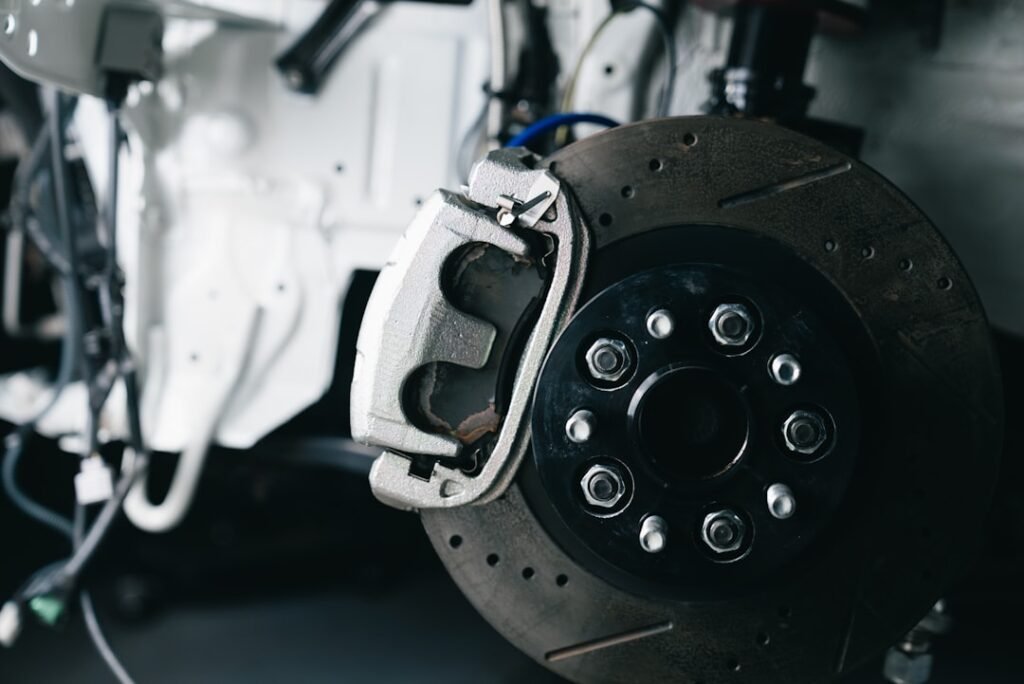
FMVSS 135 S5.1.2(b) is a right, so here is how to use it. On most cars with alloy wheels you can see the outer pad through the spokes without removing anything.
- Park on level ground and let the brakes cool. A rotor that has just done a mountain descent will burn you through a glove.
- Turn the steering to full lock in the direction of the wheel you are checking. This swings the caliper out from behind the spokes and gives you a straight line of sight.
- Find the caliper, then the rotor, then the sandwich between them. The friction material is the softer-looking layer bonded to a steel backing plate. What you are measuring is the friction material only — not the plate.
- Look for the wear indicator tab if there is one: a thin curved steel finger on the edge of the pad, standing proud of the friction surface. Its tip marks the depth at which it starts to sing.
- Measure it. You do not need a caliper for the first pass. A 1/8-inch drill bit is 3.175 mm across — the same figure the federal government uses as the minimum for air disc brakes on a truck — so if the friction material is visibly thinner than the shank of that bit, start planning the job. A steel rule with millimeter marks laid against the pad edge gives you the actual number.
- Do the same for the inner pad if you can see it from behind the strut, and note that the inner pad is usually the one that goes first, because the piston is on that side.
- Write the number down with the odometer reading next to it. One measurement is a snapshot. Two measurements six months apart are a wear rate, and a wear rate is a prediction.
If you can see the pad and there is no wear indicator visible, the manufacturer chose option (b) — which means this check is the check they intended you to do.
What is in a brake pad, and what two states have legislated out of it
Nothing about brakes surprised me more than this, and none of the fifteen readable pages mentions it once.
Brake dust is not inert. It is friction material abraded off the pad and washed off the road into storm drains. Washington State says so in the findings of its own law, RCW 70A.340.010:
“Thousands of pounds of copper and other substances released from brake friction material enter Washington state’s streams, rivers, and marine environment every year … Copper is toxic to many aquatic organisms.”
Two states wrote that into statute, on the same schedule. California’s is Health and Safety Code Article 13.5, sections 25250.50 to 25250.65, added by SB 346 in 2010. Washington’s is RCW 70A.340. And on 21 January 2015 the EPA, several states and the automotive industry signed a national memorandum of understanding — the Copper-Free Brake Initiative — that adopted the same targets for the rest of the country.
| From | Limit on brake friction material sold in CA and WA | Citation |
|---|---|---|
| 1 Jan 2014 | asbestiform fibers, lead, mercury, chromium(VI) each ≤0.1% by weight; cadmium ≤0.01% | Cal. HSC 25250.51 |
| 1 Jan 2021 | copper ≤5% by weight | Cal. HSC 25250.52 |
| 1 Jan 2025 | copper ≤0.5% by weight | Cal. HSC 25250.53 |
Two things in that table deserve a second look.
Asbestos was not banned from brake pads sold in California until 2014 — and section 25250.51(b) let dealers, wholesalers and retailers keep selling non-certified stock “solely for the purpose of depletion of inventories until December 31, 2023.” A brake pad legally sold in California at the end of 2023 could have been made to pre-2014 chemistry.
The 0.5% copper limit started this year. If you have bought pads since January, they are made to a formulation that did not legally exist for new vehicles before 2025.
And there is a mark. Cal. HSC 25250.60(c)(2), (e)(2) and (g)(2) each require that “a vehicle brake friction material manufacturer shall mark proof of certification … on all brake friction materials”, and 25250.60(a) says the mark must “identify the brake friction material manufacturer, be easily applied, be easily legible”. Washington requires the same thing in RCW 70A.340.080.
The statute goes further than the mark. Under 25250.60(h) a manufacturer has to file the certification for each formulation with a testing certification agency before selling it, and that certification “shall be made available within a reasonable period of time on the testing certification agency’s Internet Web site at no cost to the department and to the public.” The recipe of the pad on your car is, by law, a published document. And 25250.60(j) requires the mark to “show a consistent date format, designation, and labeling to facilitate acceptance in all 50 states and United States territories” — which is why a mark written for two states ends up on boxes sold everywhere.
So the compliance tier is printed on the box in front of you, and the formulation behind it is public. Zero of the fifteen pages that rank for this question mention that any of it exists.
Two footnotes worth having. Motorcycles are exempt from the whole California article — 25250.55(d). And the copper limits apply according to the vehicle’s manufacture date: 25250.55(g) and (h) exempt vehicles built before 2021 and before 2025 from the respective limits.
Electric cars: the pads last far longer, and that is the problem
If you drive an EV or a hybrid, most of your stopping is not done by the pads at all. FMVSS 135 S5.1.3(a) defines when the regenerative system legally counts as part of the service brakes:
“For an EV equipped with RBS, the RBS is considered to be part of the service brake system if it is automatically activated by an application of the service brake control, if there is no means provided for the driver to disconnect or otherwise deactivate it, and if it is activated in all transmission positions, including neutral.”
And S5.5.1(g) requires the brake warning light to come on if that system fails. The regulation treats the motor as a brake, because it is one.
The consequence for maintenance is not the one people expect. Pads on an EV are not consumed at the normal rate, so the friction surfaces spend months barely touching. Rust forms on the rotor face and, without regular abrasion, it does not get polished off — the same overnight surface rust that causes a morning squeak on any car, except it never gets scrubbed away. What you end up watching for shifts from worn out towards corroded and sticking — which is a calendar problem rather than a mileage problem.
Which means that on an EV the question “how long do brake pads last” has the wrong units. The useful measurements are how long since the calipers were last serviced and how long since the pads did real work — both of which are dates, not distances. A few hard stops from highway speed on an empty road, occasionally and deliberately, do more for an EV’s brakes than any interval.
So how long do brake pads last?
No federal document answers this. FMVSS 135 contains no mileage. Part 570 contains none. Neither does § 393.47. Every number in circulation comes from somebody in the trade, and the honest thing is to say so and quote them. Jiffy Lube, one of the pages ranking on that search, gives the widest and most candid version: “the standard life of brake pads is approximately 20,000 to 65,000 miles, with an average of 40,000 miles.”
A range that wide is not a failure of knowledge. It is the correct answer, because pad life is not a property of the pad. It is a property of how much kinetic energy you ask the pad to convert into heat. The trade’s own range says as much: 65,000 divided by 20,000 is 3.25, so the same part on the same car is expected to last more than three times longer for one driver than for another.
Here is what actually moves the number, and in which direction.
| What changes it | Direction | Why |
|---|---|---|
| Stop-and-go city driving | ↓↓ | every stop is energy converted to heat at the pad; at the same speed, a commute with forty stops does forty times the work of a commute with one |
| Steady highway miles | ↑↑ | miles accumulate on the odometer without accumulating on the pads |
| Descending long grades on the brakes | ↓↓ | sustained heat glazes the friction surface and boils moisture out of old fluid |
| Towing or a loaded vehicle | ↓ | kinetic energy scales with mass |
| Vehicle mass generally | ↓ | a three-ton SUV throws away twice the energy of a 1.5-ton hatchback at the same speed |
| Front versus rear axle | front ↓ | weight transfers forward under braking, so the front brakes do the larger share of the work and normally wear out first |
| Inner versus outer pad | inner ↓ | the piston pushes the inner pad, and a lazy slide pin leaves it dragging |
| Regenerative braking (EV, hybrid) | ↑↑↑ | the motor does most of the work; see the corrosion caveat above |
| Anticipating instead of reacting | ↑ | speed shed by lifting off is speed the pads never have to absorb — the same habit that shows up in real-world fuel economy |
Reading that table is more useful than any interval, because it tells you which category you are in. If your commute is twelve miles of arterial roads with a light every quarter mile, plan for the bottom of the range. If it is forty miles of interstate, the top of the range may still be pessimistic.
The right way to turn that into a number: measure twice
You do not need to guess, and you do not need a shop to tell you. You need two measurements and the odometer readings that go with them.
Measure the outer pad as described above, write down the thickness and the mileage, and do it again at the next oil change. The difference gives you a millimeter-per-thousand-miles wear rate for your car, your commute and your right foot. Divide the material remaining by that rate and you have a replacement mileage that no article can give you, because no article knows how you drive.
That is exactly the kind of thing I built Magica to hold. It is a mileage tracker and a vehicle log: fuel-ups, services, expiry dates, and a maintenance log where a note like “front pads 7 mm at 61,400” sits next to the odometer reading, on the device, with no server involved. Two of those notes are a wear rate. Five of them are a replacement schedule you did not have to trust anybody for. And when you sell the car, that log is the difference between “brakes were done at some point” and a date, a mileage and a part.

Try Magica for Free
Download the app and start automatically tracking your business trips. No credit card required.
Download Now
If you want the wider version of the same habit, I wrote about how to keep a car maintenance log and about what a real maintenance schedule looks like once you stop copying the dealership’s version.
What the crash data says, which is not what the ranking pages imply
The pages that sell brake service tend to imply that a worn pad is a crash waiting to happen. The federal government has actually counted, and the number is worth knowing before you panic — or before you assume it does not matter.
NHTSA’s National Motor Vehicle Crash Causation Survey (DOT HS 811 059) investigated 5,471 crashes in detail and assigned a “critical reason” — the last failure in the chain — to the driver, the vehicle or the environment. The vehicle got the critical reason in 130 of the 5,471 crashes, about 2.4%. Within those 130, the report’s Table 9(b) breaks down as:
| Vehicle-related critical reason | Share of the 130 |
|---|---|
| Tires failed or degraded / wheels failed | 43.3% |
| Brakes failed or degraded | 25.0% |
| Other vehicle failure or deficiency | 20.8% |
| Steering, suspension, transmission or engine | 10.5% |
| Unknown | 0.5% |
Both readings are true and you need both. Brake failure was the critical reason in 39 of 5,471 investigated crashes, roughly one in 140 — so no, worn pads are not the thing most likely to hurt you on the way to work. And when the vehicle was the reason, brakes were the second most common cause of it, behind only tires. It is a rare failure with a bad ceiling.
Which is why the sane posture is neither panic nor neglect: measure it twice a year, know your own wear rate, and replace on evidence. The same conclusion I reached about tires, for the same reason — the two systems that show up first in that table are also the two you can inspect yourself in a driveway, for free.
What I would actually do
Stripped of everything above:
- Look at the pads twice a year. FMVSS 135 S5.1.2 guarantees you can, one way or the other. Turn the wheel to full lock and look through the spokes.
- Write the thickness down with the odometer. Two numbers make a rate; a rate makes a date.
- Treat the squeal as information, not an emergency. The tab is designed to reach the rotor while friction material is still left, so it is a warning and not a failure — but it is not a state to live in either, and every week you ignore it moves you closer to metal on metal.
- Read the number cast into the rotor before you agree to replace it. The in-use standard says it will be there on any vehicle built since 1971, and it is the difference between resurfacing and scrapping.
- Do not top up the brake fluid to hide pad wear. The reservoir is legally sized to be a wear gauge. Let it be one.
- If it is an EV, stop counting miles. Count months, and give the brakes real work occasionally.
- Check the certification mark on the box if you buy your own pads. Since 2025 there is a 0.5% copper tier, and it is printed on the product.
None of that requires trusting me, or a shop, or an AI Overview built out of Facebook posts. It requires a flashlight, four minutes, and somewhere to write two numbers down.
Frequently asked questions
How long do brake pads last in miles?
There is no federal answer — FMVSS 135, 49 CFR Part 570 and 49 CFR 393.47 all contain no mileage figure for brake pads. The trade’s own range is wide and honest: Jiffy Lube, one of the pages ranking for this question, says “approximately 20,000 to 65,000 miles, with an average of 40,000 miles.” Where you fall in that range depends far more on how many times you stop than on how far you drive.
What is the legal minimum brake pad thickness?
For a passenger car, the only number the federal government has written down is one thirty-second of an inch (0.79 mm) over the rivet heads, in 49 CFR 570.5(g) — and 49 CFR 570.3 states that the part “does not in itself impose requirements on any person”, because it is a model for state inspection programs rather than a direct rule. Commercial vehicles are different: 49 CFR 393.47(d)(1) sets enforceable minimums from 1.6 mm up to 6.4 mm depending on axle and brake type.
Why are my brakes squeaking?
Most often it is the wear indicator: a steel tab on the edge of the pad that touches the rotor before the friction material runs out. FMVSS 135 S5.1.2 requires every car sold since September 2000 to warn you either with an acoustic or optical device, or by letting you see the pads with the tools supplied with the vehicle — so an audible squeal is one of the two options the standard allows. Other causes are surface rust after rain or overnight dew, brake dust, glazed pads, missing lubrication at the caliper contacts, or a trapped stone. The wear indicator is the one that sounds continuously while rolling and stops under hard braking.
Should the brake warning light come on when the pads are worn?
Only if the manufacturer chose the electrical option. FMVSS 135 S5.5.1(d) requires the lamp for “brake lining wear-out, if the manufacturer has elected to use an electrical device to provide an optical warning to meet the requirements of S5.1.2(a)”. On a car with a mechanical squealer, the brake light will never come on for worn pads — though the fluid falling to one quarter of reservoir capacity will trigger it under S5.5.1(a)(1).
Is it safe to drive with squeaky brakes?
The squeal is designed to give you notice, not to signal immediate failure — the wear indicator contacts the rotor while friction material still remains. But it is a countdown, and the cost of ignoring it is not only safety: once the friction material is gone, the steel backing plate cuts into the rotor, and if the rotor drops below the minimum thickness cast into it (required to be findable on vehicles built since 1 January 1971, per 49 CFR 570.5(f)) it cannot be resurfaced and has to be replaced. If the noise is grinding rather than squealing, that has already started.
How can I check brake pad thickness without removing the wheel?
On most cars you can. FMVSS 135 S5.1.2(b) requires manufacturers who did not fit a warning device to provide “a means of visually checking the degree of brake lining wear, from the outside or underside of the vehicle, utilizing only the tools or equipment normally supplied with the vehicle.” Park on level ground, let the brakes cool, turn the steering to full lock, and look through the wheel spokes at the friction material between caliper and rotor. A 1/8-inch drill bit (3.2 mm) makes a quick gauge; a quarter is 1.75 mm and a nickel 1.95 mm.
Do I have to replace the rotors with the pads?
Not automatically. Every rotor built since 1 January 1971 carries a minimum thickness dimension embossed on it, and 49 CFR 570.5(f) treats that figure as the specification an inspection measures against. If the rotor is above that number, not cracked and not badly scored, it can often stay. If it is at or below it, no amount of machining brings it back. The reason rotors get replaced with pads far more often than they need to is that people wait past the squeal.
Do brake pads on an electric car last longer?
Usually far longer, because regenerative braking does most of the work — FMVSS 135 S5.1.3(a) treats a regenerative system as part of the service brake system when it activates automatically from the brake pedal and cannot be switched off. The trade-off is that the friction surfaces rarely get used, so surface corrosion on the rotors is the failure mode rather than wear. On an EV, track the calendar rather than the odometer, and use the brakes hard occasionally on purpose.
Are brake pads regulated for what they contain?
In two states, yes, and nationally by agreement. California (Health and Safety Code 25250.51-25250.53) and Washington (RCW 70A.340) have banned asbestiform fibers, lead, mercury, chromium(VI) and cadmium above trace levels since 2014, copper above 5% since 2021, and copper above 0.5% since 1 January 2025. The EPA, several states and industry signed the Copper-Free Brake Initiative on 21 January 2015 to adopt the same targets nationally. Manufacturers must mark proof of certification on the friction material itself (Cal. HSC 25250.60, RCW 70A.340.080).
How often do brake pads fail badly enough to cause a crash?
Rarely, but not never. In NHTSA’s National Motor Vehicle Crash Causation Survey (DOT HS 811 059), the vehicle was assigned the critical reason in 130 of 5,471 investigated crashes — about 2.4% — and brake failure or degradation accounted for 25.0% of those 130, second only to tires at 43.3%. That is roughly one crash in 140 overall, which argues against panic and against neglect at the same time.
—
Everything cited here comes from the Code of Federal Regulations (49 CFR 570.3, 570.5, 393.47, 571.105 and 571.135), from California Health and Safety Code sections 25250.50-25250.60 and Washington RCW 70A.340, from the EPA’s Copper-Free Brake Initiative page, and from NHTSA report DOT HS 811 059, all read directly on 24 August 2026. Regulations change and state inspection rules vary — check the current text before relying on a number for anything that matters. This is a maintenance article, not a repair manual: work on a braking system belongs to somebody qualified to do it.



2 commenti su “How Long Do Brake Pads Last? The Only Federal Number Is 1/32 Inch, and the Rule That Sets It Binds Nobody”
I commenti sono chiusi.